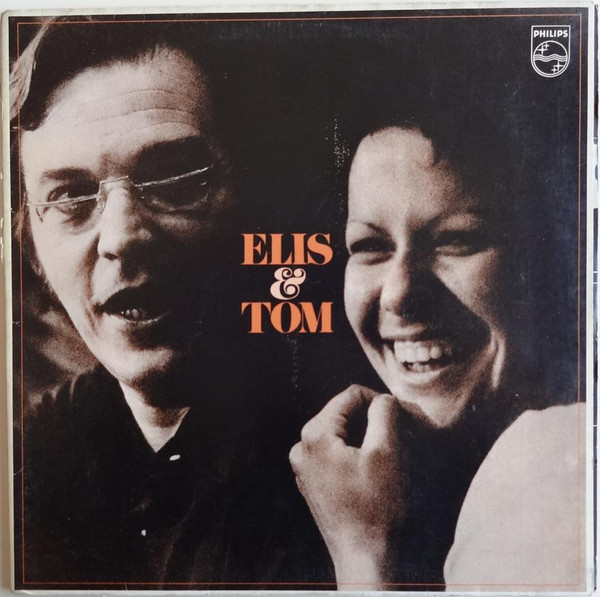
Elis & Tom
Elis Regina, Antonio Carlos Jobim
1974 · Philips · 6349.112 · Brazil
Played once on Passolio by Passolio.
Tracklist
| A1 | Águas De Março
CreditsBassLuizão Maia DrumsPaulinho Braga GuitarHélio Delmiro GuitarOscar Castro-Neves PianoAntonio Carlos Jobim PianoCésar Camargo Mariano VocalsAntonio Carlos Jobim VocalsElis Regina Written-ByAntonio Carlos Jobim | 3:29 |
| A2 | Pois É
CreditsBassLuizão Maia DrumsPaulinho Braga Electric GuitarHélio Delmiro PianoCésar Camargo Mariano VocalsElis Regina Written-ByAntonio Carlos Jobim Written-ByChico Buarque | 1:45 |
| A3 | Só Tinha De Ser Com Você
CreditsBassLuizão Maia DrumsPaulinho Braga Electric GuitarHélio Delmiro Electric PianoCésar Camargo Mariano GuitarOscar Castro-Neves VocalsElis Regina Written-ByAloysio De Oliveira Written-ByAntonio Carlos Jobim | 3:50 |
| A4 | Modinha
CreditsArranged ByAntonio Carlos Jobim Directed ByBill Hitchcock (2) PianoAntonio Carlos Jobim VocalsElis Regina Written-ByAntonio Carlos Jobim Written-ByVinicius De Moraes | 2:12 |
| A5 | Triste
CreditsArranged ByCésar Camargo Mariano BassLuizão Maia DrumsPaulinho Braga Electric GuitarHélio Delmiro GuitarOscar Castro-Neves PianoCésar Camargo Mariano VocalsElis Regina Written-ByAntonio Carlos Jobim | 2:38 |
| A6 | Corcovado
CreditsArranged ByCésar Camargo Mariano Directed ByBill Hitchcock (2) Piano, GuitarAntonio Carlos Jobim VocalsAntonio Carlos Jobim VocalsElis Regina Written-ByAntonio Carlos Jobim | 3:53 |
| A7 | O Que Tinha De Ser
CreditsPianoAntonio Carlos Jobim VocalsElis Regina Written-ByAntonio Carlos Jobim Written-ByVinicius De Moraes | 1:40 |
| B1 | Retrato Em Branco E Preto
CreditsArranged ByCésar Camargo Mariano Directed ByBill Hitchcock (2) PianoAntonio Carlos Jobim VocalsElis Regina Written-ByAntonio Carlos Jobim Written-ByChico Buarque | 3:02 |
| B2 | Brigas, Nunca Mais
CreditsBassLuizão Maia DrumsPaulinho Braga Electric GuitarHélio Delmiro Electric PianoCésar Camargo Mariano GuitarOscar Castro-Neves VocalsElis Regina Written-ByAntonio Carlos Jobim Written-ByVinicius De Moraes | 1:36 |
| B3 | Por Toda Minha Vida
CreditsArranged ByCésar Camargo Mariano Directed ByBill Hitchcock (2) VocalsElis Regina Written-ByAntonio Carlos Jobim Written-ByVinicius De Moraes | 2:02 |
| B4 | Fotografia
CreditsBassLuizão Maia DrumsPaulinho Braga Electric GuitarHélio Delmiro Electric PianoCésar Camargo Mariano PercussionChico Batera VocalsElis Regina Written-ByAntonio Carlos Jobim | 2:45 |
| B5 | Soneto De Separação
CreditsArranged ByCésar Camargo Mariano Directed ByBill Hitchcock (2) PianoAntonio Carlos Jobim VocalsAntonio Carlos Jobim VocalsElis Regina Written-ByAntonio Carlos Jobim Written-ByVinicius De Moraes | 2:18 |
| B6 | Chovendo Na Roseira
CreditsArranged ByCésar Camargo Mariano BassLuizão Maia DrumsPaulinho Braga Electric PianoCésar Camargo Mariano GuitarAntonio Carlos Jobim GuitarOscar Castro-Neves PianoAntonio Carlos Jobim PianoCésar Camargo Mariano VocalsElis Regina Written-ByAntonio Carlos Jobim | 3:10 |
| B7 | Inútil Paisagem
CreditsPianoAntonio Carlos Jobim VocalsAntonio Carlos Jobim VocalsElis Regina Written-ByAloysio De Oliveira Written-ByAntonio Carlos Jobim | 3:11 |
Release Credits
Companies
Notes
About this record
Elis & Tom is a bossa nova album that was released in 1974 and recorded by Brazilian singer Elis Regina and singer-songwriter Antônio Carlos Jobim.
Recorded over a 16-day period at MGM Studios in Los Angeles, California, the album was an old wish of Regina, who always wanted to record a full album of Jobim's songs with him. This finally came true in 1974, when Elis was celebrating her 10th anniversary as an artist of Philips Records. The label approved the project as a gift for her.
In 2004, the 30th anniversary of the initial release, a remastered special edition was released on DVD Audio which included a 5.1 multi-channel surround mix from the original master tapes.
The production and recording of this album are depicted in the 2022 documentary film Elis & Tom, Só Tinha de Ser com Você, by Roberto de Oliveira and Nelson Motta.
== Reception ==
The Allmusic review by Thom Jurek awards the album 4.5 stars and states that "This beautiful — and now legendary — recording date between iconic Brazilian vocalist Elis Regina and composer, conductor, and arranger Tom Jobim is widely regarded as one of the greatest Brazilian pop recordings."
It was ranked 11th on Rolling Stone's Top 100 Brazilian albums of all time. The album was inducted into the Latin Grammy Hall of Fame in 2007. In September 2012 it was voted by the audience of Radio Eldorado FM, of Estadao.com and of Caderno C2+Música (both the latter belong to newspaper O Estado de S. Paulo) as the fourth-best Brazilian album ever.
== Track listing ==
== Personnel ==
Elis Regina - vocals
Antônio Carlos Jobim - vocals (1, 6, 12, 14), piano (4, 6–8, 11–14), arrangement (4), guitar (6)
César Camargo Mariano - piano (1, 2, 5), electric piano (3, 9, 11, 13), arrangements (except 4)
Hélio Delmiro - guitar (1, 3, 9), electric guitar (2, 5, 11)
Oscar Castro-Neves - guitar (1–3, 5, 9, 13)
Luizão Maia - bass (1–3, 5, 9, 11, 13)
Paulo Braga - drums (1–3, 5, 9, 11, 13)
Bill Hitchcock - conductor of string section (1, 6, 8, 10,12)
Hubert Laws and Jerome Richardson - flute (1, 5, 6, 13; uncredited)
Chico Batera - percussion (11)
== References ==
Source: Wikipedia ↗
Biography: Elis Regina
Elis Regina Carvalho Costa (March 17, 1945 – January 19, 1982), known professionally as Elis Regina (Brazilian Portuguese: [eˈliz ʁeˈʒĩnɐ]), was a Brazilian singer of bossa nova, MPB and jazz music. She is also the mother of the singers Maria Rita and Pedro Mariano.
She became nationally renowned in 1965 after singing "Arrastão" (composed by Edu Lobo and Vinícius de Moraes) in the first edition of TV Excelsior festival song contest and soon joined O Fino da Bossa, a television program on TV Record. She was noted for her vocalization as well as for her interpretation and performances in shows. Her recordings include "Como Nossos Pais" (Belchior), "Upa Neguinho" (E. Lobo and Gianfrancesco Guarnieri), "Madalena" (Ivan Lins), "Casa no Campo" (Zé Rodrix and Tavito), "Águas de março" (Tom Jobim), "Atrás da Porta" (Chico Buarque and Francis Hime), "O Bêbado e a Equilibrista" (Aldir Blanc and João Bosco), "Conversando no Bar" (Milton Nascimento), "Alô, Alô Marciano" (Rita Lee and Roberto de Carvalho).
Her death, at the age of 36, shocked Brazil.
== Biography ==
Elis Regina was born in Porto Alegre, where she began her career as a singer at an early age on the children's radio show Clube de Guri. In her early teens she signed a record contract and a couple years later traveled to Rio de Janeiro, where she recorded her first album. She won her first festival song contest in 1965 singing "Arrastão" ("Pull the Trawling Net") by Edu Lobo and Vinícius de Moraes, which made her the biggest selling Brazilian recording artist since Carmen Miranda. Her second album, Dois na Bossa with Jair Rodrigues, set a national sales record and became the first Brazilian album to sell over one million copies. "Arrastão" increased her popularity because the festival was broadcast via TV and radio. The record represented the beginning of música popular brasileira (Brazilian popular music) and contrasted with bossa nova. In the late 1960s and early 1970s, she helped popularize tropicalismo with Gal Costa, Gilberto Gil, and Caetano Veloso.
In 1970 she had her first son with first husband Ronaldo Bôscoli. Later on she had two more children with musician Cesar Camargo Mariano.
Regina was nicknamed "hurricane" and "little pepper". She moved to Rio shortly before the 1964 Brazilian coup d'état which established the subsequent military dictatorship in Brazil. Although her popularity protected her from reprisal when she criticized the regime while on tour in Europe, she was threatened with imprisonment unless she sang the Brazilian national anthem at an event honoring the anniversary of the coup. In the 1970s she recorded the album Elis and Tom in Los Angeles with Antonio Carlos Jobim. In 1982 she was starting her third marriage when she died from a combination of alcohol and cocaine at the age of thirty-six.
== Death ==
On January 19, 1982, Regina died at the age of 36, from cardiac arrest, after consuming vermouth, cocaine and tranquilizers. More than 15,000 fans attended a musical wake in the Teatro Bandeirantes in São Paulo. She was buried in Cemitério do Morumbi.
== Legacy ==
On August 18, 1997 Regina was posthumously awarded with the rank of the Order of Prince Henry of Portugal.
In 2005, a memorial space was opened at the Casa de Cultura Mario Quintana in Porto Alegre, Brazil to house the Elis Regina Collection. The space exhibits audiovisuals, CDs, articles and other media materials and documents about the life and work of Regina.
Regina was portrayed by Andréia Horta in the 2016 movie "Elis" directed by Hugo Prata.
== Discography ==
=== Studio albums ===
=== Live albums ===
==== In life ====
==== Posthumous ====
=== Compilation albums ===
==== Posthumous ====
== References ==
== Further reading ==
Arashiro, Osny (1995). Elis Regina por ela mesma. M. Claret.
Echeverria, Regina (1985) Furacão Elis. Inclui cronologia e discografia por Maria Luiza Kfouri. Rio de Janeiro: Nórdica / Círculo do Livro. 363p. 2.ed. rev. ampl. 1994 (São Paulo: Ed. Globo); 3.ed. 2002 (São Paulo: Ed. Globo). 239p. ISBN 85-250-3514-9
Goés, Ludenbergue (2007). Mulher brasileira em primeiro lugar: o exemplo e as lições de vida de 130 brasileiras consagradas no exterior. Ediouro Publicações. ISBN 85-00-01998-0.
Kiechaloski, Zeca (1984) Elis Regina. Col. Esses Gaúchos. Porto Alegre: Tchê! 101p.
Pugialli, Ricardo (2006). Almanaque da Jovem Guarda: nos embalos de uma década cheia de brasa, mora? (in Portuguese). Brazil: Ediouro. ISBN 9788500020735.
Sarsano, José Roberto. (2005) Boulevard des Capucines. Teatro Olympia, Paris 1968: Elis Regina e Bossa Jazz Trio em uma época de ouro da MPB. Ed. Árvore da Terra. 207p. ISBN 85-85136-29-4
Silva, Walter (2002). Vou te contar: histórias de música popular brasileira. Conex. ISBN 85-88953-05-6.
Elis Regina Por Ela Mesma. (1995) Org. Osny Arashiro. São Paulo: Martin Claret. 2.ed. rev. 2004. 229p. ISBN 85-7232-085-7
O Melhor de Elis Regina. (2003) Melodias cifradas com as letras de 28 músicas do repertório de Elis Regina. Ed. Irmãos Vitale. 112p. ISBN 85-7407-088-2
== External links ==
"Elis Regina". Find a Grave. Retrieved September 3, 2010.
Elis Regina: The Voice of Brazil at MisterLUCKY Music at the Wayback Machine (archived 26 September 2010)
Chronology (English) from Furacão Elis The biography by Regina Echeverria at the Wayback Machine (archived 25 April 2012)
Source: Wikipedia ↗
Biography: Antonio Carlos Jobim
Antônio Carlos Brasileiro de Almeida Jobim (25 January 1927 – 8 December 1994), also known as Tom Jobim (Portuguese pronunciation: [tõ ʒoˈbĩ] ), was a Brazilian composer, pianist, guitarist, songwriter, arranger and singer. Jobim is considered a great exponent of Brazilian music and one of the fathers of bossa nova for having merged samba with cool jazz in the 1960s as a pioneer of the genre. He is also regarded as one of the most celebrated songwriters of the 20th century, and his compositions have been played and recorded by many singers and instrumentalists internationally since the early 1960s.
Jobim is best known for his composition "Garota de Ipanema (The Girl from Ipanema)", which has been recorded over 240 times by other artists, and is believed to be one of the most recorded popular songs in history. Along with "Garota de Ipanema", many of Jobim's compositions are included in jazz and pop standard repertoires. Several of these compositions are featured on the 1964 album Getz/Gilberto, which won the Grammy Awards for Best Jazz Instrumental Album – Individual or Group, Best Engineered Album, Non-Classical, and was the first jazz record to win Album of the Year. The recording of "Garota de Ipanema" that features on this album also won Record of the Year when released as a single. His 1967 album with Frank Sinatra, Francis Albert Sinatra & Antônio Carlos Jobim, was nominated for Album of the Year in 1968 and album Antônio Brasileiro was awarded the 1995 Grammy Award for Best Latin Jazz Album.
== Early life ==
Antônio Carlos Jobim was born at 23:15 BRT on 25 January 1927 in the middle-class district of Tijuca in Rio de Janeiro. His father, Jorge de Oliveira Jobim (São Gabriel, Rio Grande do Sul; 1889–1935), was a writer, diplomat, professor and journalist. He came from a prominent family, being the great-nephew of José Martins da Cruz Jobim, senator, privy councillor and physician of Emperor Dom Pedro II. While studying medicine in Europe, José Martins added Jobim to his last name, paying homage to the village where his family came from in Portugal, the parish of Santa Cruz de Jovim, Porto. Antônio's mother, Nilza Brasileiro de Almeida (c. 1910–1989), was of partly indigenous descent from northeastern Brazil. Brasileiro de Almeida was only 16 years old when she gave birth to Antônio Carlos Jobim at their home in Tijuca on Rua Conde de Bonfim.
When Antônio was still an infant, his parents separated and his mother moved with her children (Antônio Carlos and his sister Helena Isaura, born 23 February 1931) to Ipanema, the beachside neighborhood the composer would later celebrate in his songs. In 1935, when the elder Jobim died, Nilza married Celso da Frota Pessoa (died 2 February 1979), who would encourage his stepson's career; he gave Jobim his first piano. Jobim credits his stepfather with encouraging him to pursue music. In an interview with Roberto d'Ávila in 1981, he said, "I hated the piano, I thought it was a girly thing, I liked to play soccer...I had a great stepfather who really helped me get involved with music and convinced me that the piano was not a girly thing." As a young man of limited means, Jobim earned his living by playing in nightclubs and bars and later as an arranger for a recording label before starting to achieve success as a composer.
Later on in the interview with Roberto d'Ávila, Jobim talks about his feelings toward his upbringing. He notes a conversation he had with Erico Verissimo, a friend of his father, in which Verissimo said that Tom Jobim should be sombre due to the absence of his father from a young age. Jobim told d'Ávila: "I was left without a father, clinging to my mother's skirts…some [men] have 'excessive' fathers, the excessive presence of their fathers is a problem, but the absence of a father is also a problem." Jobim continued with d'Ávila, sharing that it takes something of great influence to bring someone to dedicate their life to music. He said that "people who play the piano well are all handicapped". He mentions the health struggles of both Sérgio Mendes, who had osteomyelitis, and Luiz Eça, who had polio. "It takes something really strong to make you leave reality behind and begin to write songs," Jobim shared. With d'Ávila he alludes to his sadness as a young man as being the driving force that motivated him to further his pursuit in music, that he needed to be sad in order to play the piano and write. He concludes on the topic with d'Ávila that, at that point in his life (the interview having taken place in 1981) that he no longer needed to be sad to create music, that he was no longer sad as he was at the beginning of his career.
=== Musical influences ===
Jobim's musical roots were planted firmly in the work of Pixinguinha, the legendary musician and composer who began modern Brazilian music in the 1930s. Among his teachers were Lúcia Branco and, from 1941 on, Hans-Joachim Koellreutter, a German composer who lived in Brazil and introduced atonal and twelve-tone composition in the country. Jobim's mother established a school where Jobim would begin taking lessons on the piano; this is when he would meet Koellreutter. Jobim was also influenced by the French composers Claude Debussy and Maurice Ravel, and by the Brazilian composers Ary Barroso who has been described as Jobim's "most important musical influence". Among many themes, his lyrics talked about love, self-discovery, betrayal, joy and especially about the birds and natural wonders of Brazil, like the "Mata Atlântica" forest, characters of Brazilian folklore and his home city of Rio de Janeiro. In a segment with the NBC Today show in 1986, hosted by Jane Pauley, Jobim spoke about his music's origins of inspiration, saying "My music comes from this environment here, you know, the rain, the sun, the trees, the birds, the fish."
== Career ==
In the 1940s Jobim started to play piano in bars and nightclubs of Rio de Janeiro, and in the first years of the 1950s he worked as an arranger in the Continental Studio, where in April 1953 he had his first composition recorded, when the Brazilian singer Mauricy Moura recorded Jobim's composition "Incerteza", with lyrics by Newton Mendonça.
Jobim became prominent in Brazil when he teamed up with poet and diplomat Vinicius de Moraes to write the music for the play Orfeu da Conceição (1956). The most popular song from the show was "Se Todos Fossem Iguais A Você" ("If Everyone Were Like You"). Later, when the play was adapted into a film, producer Sacha Gordine did not want to use any of the existing music from the play. Gordine asked de Moraes and Jobim for a new score for the film Orfeu Negro, or Black Orpheus (1959). Moraes was at the time away in Montevideo, Uruguay, working for the Itamaraty (the Brazilian Ministry of Foreign Affairs) and so he and Jobim were only able to write three songs, primarily over the telephone ("A felicidade", "Frevo" and "O nosso amor"). This collaboration proved successful, and de Moraes went on to pen the lyrics to some of Jobim's most popular songs.
In 1958 the Brazilian singer and guitarist João Gilberto recorded his first album with two of Jobim's most famous songs, "Desafinado" and "Chega de Saudade". This album inaugurated the Bossa Nova movement in Brazil. The sophisticated harmonies of his songs caught the attention of jazz musicians in the United States, principally after his first performance at Carnegie Hall, in 1962.
A key event in making Jobim's music known in the English-speaking world was his collaboration with the American jazz saxophonist Stan Getz, the Brazilian singer João Gilberto, and Gilberto's wife at the time, Astrud Gilberto, which resulted in two albums, Getz/Gilberto (1964) and Getz/Gilberto Vol. 2 (1966). The release of Getz/Gilberto created a bossa nova craze in the United States and subsequently internationally. Getz had previously recorded Jazz Samba with Charlie Byrd (1962), and Jazz Samba Encore! with Luiz Bonfá (1964). Jobim wrote many of the songs on Getz/Gilberto, which became one of the best-selling jazz albums of all time, and turned Astrud Gilberto, who sang on "Garota de Ipanema" ("The Girl from Ipanema") and "Corcovado" ("Quiet Nights of Quiet Stars"), into an international sensation. At the Grammy Awards of 1965 Getz/Gilberto won the Grammy Award for Album of the Year, the Grammy Award for Best Jazz Instrumental Album, Individual or Group and the Grammy Award for Best Engineered Album, Non-Classical. "The Girl from Ipanema" won the Grammy Award for Record of the Year. Among his later hits is "Águas de Março" ("Waters of March", 1972), for which he wrote both the Portuguese and English lyrics, and which was then translated into French by Georges Moustaki (as "Les Eaux de Mars", 1973).
In talking about his creative process when writing and creating "Girl From Ipanema", Jobim told Roberto d’Ávila in 1981, "It comes to me in a way, then it changes one or two times and all of the sudden, it becomes something that makes sense…it's like the profile of a woman…the profile of a woman, something very discernible, then you say: ‘hey, this is really beautiful…’ then you stare and as soon as you stare, it's gone, I mean it becomes part of the past." Jobim continues, "I mean, every time you draw something it turns into, it's something static… that portrait remains forever."
=== Collaboration with Elis Regina c. 1974–1982 ===
Jobim and Elis Regina first met in 1974 in Los Angeles, when Regina was only 29 years old and still a fresh face in the Brazilian music industry. Regina was a force to be reckoned with, being referred to as furacão ("hurricane" in English) by those who worked with and around her. The two artists came together to create the album Elis & Tom which would unexpectedly become tremendously popular in the United States as well as across the globe. Regina and Jobim had a special creative chemistry between them that was noted by those who were present to witness the collaborative process first hand during that era in both of their careers. Oscar Castro-Neves, a guitarist-producer who worked with Regina and Jobim on the Elis & Tom album in the mid-1970s, recalled in an article with the Los Angeles Times that "There was a very fine line between ‘rehearsal’ and ‘hanging out,’ ‘just talking’...it was all that seamless." Due to the nature of their work relationship, Regina and Jobim grew close and had a symbiosis that is reflected in the result of their work together. "Aguas de março" represents this, with the lyrics simulating a banter of finishing each other's sentences.
== Personal life ==
Jobim was married to Thereza Otero Hermanny on 15 October 1949 and had two children with her: Paulo Jobim (1950–2022), an architect and musician and father of Daniel Jobim (born 1973) and Dora Jobim (born 1976); and Elizabeth "Beth" Jobim (born 1957), a painter. Jobim and Thereza divorced in 1978. On 30 April 1986, he married 29-year-old photographer Ana Beatriz Lontra, with whom he had two more children: João Francisco Jobim (1979–1998) and Maria Luiza Helena Jobim (born 1987). Daniel, Paulo's son, followed his grandfather to become a pianist and composer, and performed "The Girl from Ipanema" during the opening ceremony of the 2016 Summer Olympics in Rio de Janeiro.
== Death ==
In early 1994, after finishing his album Antonio Brasileiro, Jobim complained to his doctor, Roberto Hugo Costa Lima, of urinary problems. Jobim was diagnosed with bladder cancer and underwent treatment, although he postponed surgery. He underwent an operation at Mount Sinai Hospital in New York City on 2 December 1994. At 7:00 EST on 8 December, while recovering from surgery, he had a cardiac arrest caused by a pulmonary embolism, and two hours later, another cardiac arrest, from which he died. He was survived by his children and grandchildren. His last album, Antonio Brasileiro, was released posthumously, just days after his death.
His body lay in state until given a proper burial on 20 December 1994. He is buried in the Cemitério São João Batista in Rio de Janeiro.
== Legacy ==
Jobim is widely regarded as one of the most important songwriters of the 20th century. Many of his songs are jazz standards. American jazz singers Ella Fitzgerald and Frank Sinatra prominently featured Jobim's songs on their albums Ella Abraça Jobim (1981) and Francis Albert Sinatra & Antônio Carlos Jobim (1967), respectively. The 1996 CD Wave: The Antonio Carlos Jobim Songbook included performances of Jobim tunes by Oscar Peterson, Herbie Hancock, Chick Corea and Toots Thielemans.
Jobim was an innovator in the use of sophisticated harmonic structures in popular song. Some of his melodic twists included the melody insisting on the major seventh of the chord.
The Brazilian collaborators and interpreters of Jobim's music include Vinicius de Moraes, João Gilberto (often credited as a co-creator or creator of bossa nova), Chico Buarque, Edu Lobo, Gal Costa, Elis Regina, Sérgio Mendes, Astrud Gilberto and Flora Purim. Buarque said in 1999 he has a drawer full of tapes gifted to him by Jobim. Significant arrangements of Jobim's compositions were written by Eumir Deodato, Nelson Riddle, and especially the conductor/composer Claus Ogerman.
He won a Lifetime Achievement Award at the 54th Grammy Awards in 2012. As a posthumous homage, on 5 January 1999, the Municipality of Rio de Janeiro changed the name of Rio's Galeão International Airport, located on Governador Island, to bear the composer's name. Galeão Airport is explicitly mentioned in his composition "Samba do Avião". In 2014, Jobim was posthumously inducted to the Latin Songwriters Hall of Fame. In 2015, Billboard named Jobim as one of The 30 Most Influential Latin Artists of All Time.
He was nominated for five Grammy Awards, including Best New Artist at the 7th Grammy Awards, where he lost to the Beatles. He won Best Latin Jazz Performance for the album titled Antonio Brasileiro at the 38th Annual Grammy Awards.
Written by Elliott Smith, the ninth track on Oregon alternative rock band Heatmiser's 1994 album Cop and Speeder is entitled "Antonio Carlos Jobim".
American contemporary jazz singer Michael Franks dedicated his 1995 album Abandoned Garden to the memory of Jobim. English singer/songwriter George Michael frequently acknowledged Jobim's influence. His 1996 album Older was dedicated to Jobim, and he recorded "Desafinado" on Red Hot + Rio (1996) with Astrud Gilberto.
Following a public vote, the official mascot of the 2016 Summer Paralympics in Rio de Janeiro, Tom, was named after him.
In 2015, a crater on the planet Mercury was named in his honor by the IAU.
== Discography and compositions ==
== References ==
== Sources ==
Cabral, Sergio (2008). Antônio Carlos Jobim – Uma Biografia (1st ed.). São Paulo, Brazil: IBEP Nacional. ISBN 978-85-7865-011-7.
Castro, Ruy (2000). Bossa Nova: The Story of the Brazilian Music That Seduced the World (1st English-Language ed.). Chicago: A Capella Books. ISBN 978-1-55652-409-7.
De Stefano, Gildo, Il popolo del samba, La vicenda e i protagonisti della storia della musica popolare brasiliana, preface by Chico Buarque de Hollanda, introduction by Gianni Minà, RAI-ERI, Rome 2005, ISBN 8839713484
De Stefano, Gildo, Saudade Bossa Nova: musiche, contaminazioni e ritmi del Brasile, preface by Chico Buarque, introduction by Gianni Minà, Logisma Editore, Florence 2017, ISBN 978-88-97530-88-6
Jobim, Helena (2011). Antonio Carlos Jobim: an illuminated man. Montclair, NJ: Hal Leonard. ISBN 978-1-61780-343-7. OCLC 709673747.
McGowan, Chris; Pessanha, Ricardo (2008). The Brazilian Sound: Samba, Bossa Nova and the Popular Music of Brazil (2nd ed.). Philadelphia, PA: Temple University Press. ISBN 978-1592139293.
== External links ==
Antônio Carlos Jobim – tribute site
Antônio Carlos Jobim – remembrance site
Antônio Carlos Jobim discography at Discogs
Antônio Carlos Jobim at IMDb
Antônio Carlos Jobim Archived 15 January 2020 at the Wayback Machine at The Brazilian Sound
Antônio Carlos Jobim – "Clube do Tom"
Antônio Carlos Jobim – behind the scenes of the legendary bossa nova concert at Carnegie Hall in 1962 (in Portuguese)
Source: Wikipedia ↗
Elsewhere
Discogs ↗ AllMusic ↗ Rate Your Music ↗
Recent plays
- 17 Jun 2026 · Side 1 · Passolio