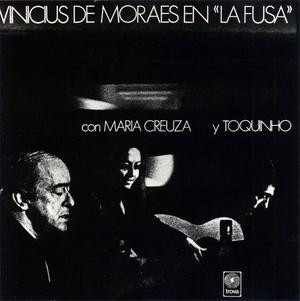
Vinicius De Moraes En La Fusa
Vinicius De Moraes, Maria Creuza, Toquinho
1989 · Trova · JW-5000 · Spain
Played once on Passolio by Passolio.
Tracklist
| A1 | Copa Do Mundo
CreditsWritten-ByUnknown Artist | 3:15 |
| A2 | A Felicidade
CreditsWritten-ByAntonio Carlos Jobim Written-ByVinicius De Moraes | 3:15 |
| A3 | Tomara
CreditsWritten-ByTraditional | 2:53 |
| A4 | Que Maravilha
CreditsWritten-ByJorge Ben Written-ByToquinho | 2:15 |
| A5 | Lamento No Morro
CreditsWritten-ByAntonio Carlos Jobim Written-ByVinicius De Moraes | 2:09 |
| A6 | Berimbau-Consolocao
CreditsWritten-ByBaden Powell Written-ByVinicius De Moraes | 2:37 |
| A7 | Irene
CreditsWritten-ByCaetano Veloso | 2:24 |
| A8 | Canto De Ossanha
CreditsWritten-ByBaden Powell Written-ByVinicius De Moraes | 2:52 |
| B1 | Garota De Ipanema
CreditsWritten-ByAntonio Carlos Jobim Written-ByVinicius De Moraes | 2:10 |
| B2 | Samba Em Preludio
CreditsWritten-ByBaden Powell Written-ByVinicius De Moraes | 3:38 |
| B3 | Catende
CreditsWritten-ByAntonio Carlos Pinto Written-ByIldásio Tavares Written-ByJocafi | 4:35 |
| B4 | Valsa De Tunisia
CreditsWritten-ByVinicius De Moraes | 3:01 |
| B5 | Eu Sei Que Vou Te Amar
CreditsWritten-ByAntonio Carlos Jobim Written-ByVinicius De Moraes | 3:27 |
| B6 | Minha Namorada
CreditsWritten-ByCarlos Lyra Written-ByVinicius De Moraes | 3:47 |
| B7 | Si Todos Fossem Iguais A Voce
CreditsWritten-ByAntonio Carlos Jobim Written-ByVinicius De Moraes | 2:33 |
Release Credits
Companies
Notes
About this record
En La Fusa con Maria Creuza y Toquinho (also known as Grabado en Buenos Aires con Maria Creuza y Toquinho) is a 1970 album by Vinicius de Moraes in partnership with Maria Creuza and Toquinho. It was recorded before a studio audience at Estudios ION in Buenos Aires in July 1970. The recording was inspired by a June 1970 engagement at the La Fusa Bar in Buenos Aires. Applause and ambience from La Fusa was mixed into the studio recordings, together with the live studio audience sounds.
== Track listing ==
Copa do mundo (Maugeri, Müller, Sobrinho e Dagô) - 01:12
A felicidade (Vinicius de Moraes / Antonio Carlos Jobim) - 03:27
Tomara (Vinicius de Moraes) - 04:17
Que maravilha (Jorge Ben / Toquinho)- 02:28
Lamento no morro (Vinicius de Moraes / Antonio Carlos Jobim) - 02:24
Berimbau / Consolação (Vinicius de Moraes / Baden Powell) - 02:46
Irene (Caetano Veloso) - 02:33
Canto de Ossanha (Vinicius de Moraes / Baden Powell) - 03:05
Garota de Ipanema (Vinicius de Moraes / Antonio Carlos Jobim) - 02:23
Samba em prelúdio (Vinicius de Moraes / Baden Powell) - 03:49
Catendé (Antônio Carlos & Jocáfi / Ildásio Tavares) - 05:10
Valsa da Tunisia (Vinicius de Moraes) - 03:08
Eu sei que vou te amar (Vinicius de Moraes / Antonio Carlos Jobim) - 03:28
Minha namorada (Vinicius de Moraes / Carlos Lyra) - 03:57
Se todos fossem iguais a você (Vinicius de Moraes / Antonio Carlos Jobim)- 02:57
== Personnel ==
Vinícius de Moraes - lyrics
Maria Creuza – vocals
Toquinho – arrangements, vocals, guitar
Enrique Roizner - drums
== References ==
Source: Wikipedia ↗
Biography: Vinicius De Moraes
Marcus Vinícius da Cruz e Mello Moraes (19 October 1913 – 9 July 1980), better known as Vinícius de Moraes (Brazilian Portuguese: [viˈnisjuz dʒi moˈɾajs]) and nicknamed "O Poetinha" ("The Little Poet"), was a Brazilian poet, diplomat, lyricist, essayist, musician, singer, and playwright. With his frequent and diverse musical partners, including Antônio Carlos Jobim, his lyrics and compositions were instrumental in the birth and introduction to the world of bossa nova music. He recorded numerous albums, many in collaboration with noted artists, and also served as a successful Brazilian career diplomat.
== Early life ==
Moraes was born in Gávea, a neighbourhood of Rio de Janeiro, to Clodoaldo da Silva Pereira Moraes, a public servant, and Lidia Cruz, a housewife and amateur pianist. In 1916, his family moved to Botafogo, where he attended Afrânio Peixoto Primary School. Fleeing the Copacabana Fort revolt, his parents moved to Governador Island while Moraes remained at his grandfather's home in Botafogo to finish school. During visits with his parents on weekends and holidays, he became acquainted with the accomplished composer Ary Barroso.
Beginning in 1924, Moraes attended St. Ignatius, a Jesuit high school, where he sang in the choir and wrote theatrical sketches. Three years later, he became friends with the brothers Paulo and Haroldo Tapajós, with whom he wrote his first musical compositions, which were performed at friends' parties. In 1929, he completed high school and his family moved back to Gávea. That same year, he was admitted to the Faculty of Law at the Federal University of Rio de Janeiro (UFRJ). At the "School of Catete", he became friends with essayist and future novelist Otávio de Faria, a Catholic militant and leader of a group of right-wing Catholics organized around Centro Dom Vital, a think-tank created by Jackson de Figueiredo shortly before his death.
Faria encouraged Moraes' literary vocation, and tried to recruit him to the conservative cause. Moraes received his college degree in Legal and Social Sciences in 1933. Soon after, he published his first two collections of poetry: Caminho para a distancia ("Path into the Distance") (1933) and Forma e exegese ("Form and Exegesis"). Both collections were composed and published under Octavio de Faria's informal editorship. The collections were symbolist poetry concerned with Catholic mysticism and the search for redemption of sexual seduction.
In his essay "Two Poets" (1935), Faria compared Moraes' poetry to that of Augusto Frederico Schmidt. The tension between Faria's and Moraes' shared Catholic activism and Faria's unrequited attraction to Moraes strained their friendship. Faria attempted suicide because of this unrequited love. Despite their estrangement, Moraes wrote two sonnets, the first in 1939 ("Sonnet to Octavio de Faria"), the second during the 1960s ("Octavio") in carefully couched praise of his friend.
In 1936, Moraes became a film censor for the Ministry of Education and Health. Two years later, he won a British Council fellowship to study English language and literature at Magdalen College, Oxford University. He abandoned his use of blank verse and free verse in favor of the sonnet, both the Italian form used in Portuguese poetry (two quatrains, two tercets) and the English form (three quatrains and a couplet). He was considered one of the most prominent of the "Generation of '45", a group of Brazilian writers in the 1930s and 1940s who rejected early modernism in favor of traditional forms and vocabulary. If João Cabral de Melo Neto's works and technique served the depiction of objective reality, those of Moraes served the depiction of the subjective mood of sexual love. The basic meter in Moraes' love poetry is the decasyllable, taken mostly from Camões's lyric poetry.
During his stay in England, Moraes wrote the verse collection Novos poemas ("New Poems"). While there, he married (by proxy) Beatriz Azevedo de Mello, with whom he subsequently had two children: filmmaker Suzana de Moraes and Pedro. In 1941, he returned to Brazil and worked as a film critic for the newspaper A Manhã ("The Morning"), as a contributor to the literary journal Clima ("Climate"), and at the Banking Employees' Institute of Social Security, the public pension fund for workers in banking institutions.
During the following year, he failed the admission test for a diplomatic career at the Ministry of Foreign Affairs (MRE). Shortly after, he was hired to accompany American writer Waldo Frank, a literary acquaintance, on tour across northern Brazil. In Moraes' words, it was contact with both Frank and "appalling poverty" that turned him into "a man of the Left".
In 1943, Moraes passed the MRE admission test on his second attempt and as his first posting was assigned as vice-consul at the Brazilian Consulate in Los Angeles, California. There, he published a book of poems, Cinco elegias ("Five Elegies"), followed by Poemas, sonetos e baladas ("Poems, Sonnets, and Ballads"). After his father died in 1950, he went to Brazil, then returned to Los Angeles and published two more books: Livro de sonetos ("Book of Sonnets") and Novos poemas II ("New Poems II"). Continuing his diplomatic career, during the 1950s, Moraes worked for the Brazilian consular service in Paris and Rome. In Rome, he often visited historian Sergio Buarque de Holanda (father of the musician Chico Buarque de Holanda), who was teaching in Italy as a visiting scholar.
In 1951, Moraes married his second wife, Lila Maria Esquerdo e Boscoli. He wrote film reviews for Samuel Wainer's Vargoist paper Última Hora. He was named a delegate to the Punta del Este film festival and was given a commission to study the management of film festivals at Cannes, Berlin, Locarno, and Venice, in view of the forthcoming São Paulo Cinema Festival, which was to be a part of the commemoration of the city's 400th anniversary.
In 1953, his third child, Georgiana, was born, and his fourth child with Lila Maria was born in 1956. He went to Paris as the second secretary at the Brazilian embassy in France. He released his first samba, "Quando tu passas por mim" ("When You Pass By"), which was composed with Antônio Maria. During the next year, he wrote lyrics to chamber music pieces by Cláudio Santoro. He became a well-known playwright with the staging of his musical Orfeu da Conceição ("Orpheus of the Conception") in 1956 and for the film made of it called Black Orpheus. He met pianist Tom Jobim, who was commissioned to write music for the play. Jobim wrote "Se todos fossem iguais a você" ("If Others Were Like You"), "Um nome de mulher" ("A Woman's Name"), and other songs included in the production. The play was staged in 1956 in São Paulo and Rio de Janeiro, having its text published in a deluxe edition illustrated by Carlos Scliar. At the end of 1956, Moraes returned to France, having been transferred in 1957 from the Brazilian embassy to the Brazilian representation at UNESCO in Paris. In 1958, he was transferred to the Brazilian embassy in Montevideo, returning to Brazil in transit. While in Brazil, he married Maria Lucia Proença.
== Bossa nova ==
Elizete Cardoso's Canção do Amor Demais -- a seminal album in the development of bossa nova -- consists of compositions by Jobim and Moraes, either working together or solo ("Canção do Amor Demais", "Luciana", "Estrada Branca", "Chega de Saudade", "Outra Vez"...). The recording also included a relatively unknown João Gilberto on two tracks. With the release of this record, Moraes's career in music had begun.
In August 1962, Moraes performed for the first time as a singer with Jobim and Gilberto at the Au Bon Gourmet in Rio. This was the first of his "pocket-shows", performances made to small audiences where he presented new compositions, some of which became international hits, such as the "Garota de Ipanema" ("The Girl from Ipanema"), as well as "Samba da Benção". Moraes introduced promising singers of the time, such as Nara Leão. Moraes wasn't a natural singer. He had a flat, nasal baritone voice, but he used background vocalists to sweeten the sound. His first undertaking as entertainer ended in 1963, when he returned to his post in the Brazilian representation at UNESCO, after his marriage to Nelita Abreu Rocha, his fourth wife.
== Cinema recognition and collaborations ==
His play Orfeu da conceição (Orpheus of the Conception), a reworking of the story of Orpheus and Eurydice set in the carnival of Rio, was adapted into the film Black Orpheus, which won an Academy Award in 1959 as Best Foreign Language Film. It was awarded the Palme d'Or at the Cannes International Film Festival and the 1960 British Academy Award. De Moraes hated the film, however, leaving mid-screening and shouting that his play had been "disfigured";[1] the film has been criticized in Brazil since release for its exoticism and stereotyping of Brazilians.[2] The film was a co-production among France, Italy, and Brazil and included "A felicidade" ("Happiness"), a song by Jobim and Moraes, which became an international hit. His song "Samba da bênção" ("The Blessing Samba") was included on the soundtrack of A Man and a Woman (Un homme et une femme, 1966), another Cannes film festival winner.
== Later life ==
During the 1960s and 1970s, Moraes collaborated with Baden Powell on a series of songs known as the Afro sambas. He collaborated with Edu Lobo on the Elis Regina hit song "Arrastão".
During a purge at the Ministry of Foreign Relations, he was forcibly retired in 1969 at the age of 55. Although taken aback by his forced retirement, he laughed at the case against him. When it was made known that the ministry purge was directed against "homosexuals and drunks", he jokingly retorted that his alcoholism was public knowledge.
In the 1970s, Moraes collaborated with Antônio Pecci Filho, a guitarist and vocalist nicknamed Toquinho, on musical and literary works. He married three women in succession: Cristina Gurjão, with whom he had a daughter, Maria; the actress Gesse Gessy; and the Argentinian Marta Rodrigues Santamaria. He toured Europe with Chico Buarque and Nara Leão, and Argentina with Dorival Caymmi and Oscar Castro-Neves. His most stable musical partnership, however, remained with Toquinho, with whom he released popular albums. Their live performances in Brazil and Europe were often conducted as intimate meetings with the public. Moraes sat onstage at a table with a checked tablecloth and a bottle of whiskey, chatting and telling amusing stories to the audience in French, English, Spanish, Italian, and Portuguese.
== Death and legacy ==
Moraes was a chain smoker and alcoholic who said, "O uísque é o melhor amigo do homem—é o cão engarrafado" ("Whiskey is man's best friend, it's the dog in a bottle"), After a long period of poor health, which included several visits to rehabilitation clinics, he died at his home in Rio de Janeiro on 9 July 1980, at the age of 66, in the company of his ninth wife, Gilda de Queirós Mattoso, and the faithful Toquinho. He is buried in Rio de Janeiro's Cemitério São João Batista.
In 2006, Moraes was posthumously reinstated to the Brazilian diplomatic corps. In February 2010, Brazil's lower house, the Camara dos Deputados, approved his posthumous promotion to ambassador.
In December 2014, following a three-week public vote, the mascot of the 2016 Summer Olympics was named after him.
In 2019, singer Mart'nália released an album paying tribute to Vinicius' work, which won the Latin Grammy for Best Samba/Pagode Album.
== Discography ==
== References ==
== External links ==
International Jose Guillermo Carrillo Foundation
Vinicius de Moraes at IMDb
(in Portuguese) Official site
Vinícius de Moraes recorded for the literary archive in the Hispanic Division at the Library of Congress on August 22, 1974 at the Library of Congress Field Office in Rio de Janeiro.
Source: Wikipedia ↗
Biography: Maria Creuza
Maria Creuza Silva Lima (born 26 February 1944), commonly known as Maria Creuza, is a Brazilian singer. She is best known for her collaboration with Vinicius de Moraes and Toquinho.
== Early life ==
Maria Creuza was born on 26 February 1944 in Esplanada, Bahia, Brazil. Her mother was a seamstress who owned a workshop with a friend. At the age of two, her parents separated, and she moved with her mother to Salvador.
Her mother's love for singing inspired Creuza to become a singer. When she was 15 years old, she joined a group called Les Girls as a crooner. Due to her participation in Les Girls, she was invited to perform on radio programs in Salvador. Creuza then hosted a program called Encontro com Maria Creuza on TV Itapoan for four years. During this time, she made her first recordings in English with a local record label.
== Career ==
=== Early career ===
In 1965, Creuza met Antônio Carlos Marques Pinto. She, along with Pinto, participated in the 1966 Festival Brasil Canta music competition, performing his song "Se não houvesse Maria". In 1967, they took part in the third Festival de Música Popular Brasileira with Pinto's song "Festa no terreiro de Alaketu". They recorded a single with the song "Abolição" the same year.
In 1969, Creuza won the best performer prize and took third place overall in the fourth Festival Universitário da Canção Popular with the song "Mirante" by Aldir Blanc and César Costa Filho. The same year, she performed "Catendê" by the newly-formed music duo of Antônio Carlos Marques Pinto and João Carlos Figueiredo (Jocafi) in the fifth Festival da Música Popular Brasileira.
=== Collaboration with Vinicius de Moraes ===
Creuza's performance in the Festival Universitário da Canção Popular caught the attention of the renowned poet and songwriter Vinicius de Moraes, who was captivated by her velvety and deep voice. De Moraes invited her on a tour in Argentina and Uruguay with Dori Caymmi, which she accepted.
During the tour, Creuza, along with de Moraes and Toquinho, who substituted for Caymmi, recorded the album En La Fusa con Maria Creuza y Toquinho at the Estudios ION in Buenos Aires in July 1970. En La Fusa was successful enough that a follow-up album, with Maria Bethânia in place of Creuza, was recorded the following year. In 2004, En La Fusa con Maria Creuza y Toquinho received the gold certification from the Argentine Chamber of Phonograms and Videograms Producers.
Creuza continued to collaborate with de Moraes and Toquinho until de Moraes's death in 1980. They toured extensively, mainly around South America and Europe. In 1972, they collaborated on the album Eu sei que vou te amar, a Brazilian version of the La Fusa set.
=== Solo career ===
In 1971, Creuza recorded the album Yo… Maria Creuza, featuring songs by Jorge Ben, Tom Jobim, Vinicius de Moraes, and Dorival Caymmi. She then recorded the albums Maria Creuza and Voce Abusou in 1972. The next year, she released Eu disse adeus, which was also recorded in Spanish for the European audience.
In 1974, Creuza released the album Sessão Nostalgia. The same year, she took part in the second World Popular Song Festival in Tokyo, winning second place with the song "Que diacho de dor" by Pinto and Jocafi.
Creuza continued to record albums through the late 1970s, including Maria Creuza e os grandes mestres do samba (1975), Meia Noite (1977), Doce veneno (1978), and Pecado (1979). In 1977, she contributed to the soundtrack of the movie Os Pastores da Noite.
In the 1980s, Creuza released the albums Maria Creuza (1980), Sedução (1981), Poético (1982), dedicated to Vinicius de Moraes, Paixão acesa (1985), Pura magia (1987), Da cor do pecado (1989), and Com Açúcar E Com Afeto (1989).
In 1991, she released the album Todo sentimento. In 1993, she and Carlos Lyra recorded the song "Samba da Benção" for the album Vinicius de Moraes Songbook Vol. 1, part of a three-volume series of works by de Moraes covered by various interpreters.
In 1998, Creuza was part of the group of singers who performed 14 songs of the century as selected by critics from Rio de Janeiro and São Paulo in a concert to celebrate the centenary of the Brazilian Academy of Letters.
=== Later career ===
In 2003, Creuza released Você e eu, consisting of interpretations of works by de Moraes, and in 2006 Maria Creuza ao vivo.
Creuza, along with Toquinho, performed at the 2016 Byblos International Festival in Lebanon.
She has been performing regularly at the Vinicius Bar in Rio de Janeiro, along with shows in Europe.
== Personal life ==
Creuza was married to the musician Antônio Carlos Marques Pinto for 17 years. They had three children. She later married her current husband, the Argentinian pianist Victor Díaz Vélez.
== Discography ==
== References ==
== External links ==
Maria Creuza profile on Discogs
Source: Wikipedia ↗
Biography: Toquinho
Antônio Pecci Filho (born July 6, 1946), better known as Toquinho (Brazilian Portuguese pronunciation: [toˈkĩɲu]), is a Brazilian singer and guitarist. He is well known for his collaborations, as composer and performer, with Vinicius de Moraes.
== Childhood and musical studies ==
Toquinho was born in São Paulo to Diva Bondioli and Antônio Pecci. He has one brother, João Carlos Pecci. He has Italian ancestry, with his paternal grandfather being from Toro, Molise, his paternal grandmother being born in Calabria, and his maternal grandparents hailing from Mantua. As he was very short as a child, his mother used to call him "meu toquinho de gente" ("my piece of person"), which was the origin of his nickname.
His first guitar lessons were with Dona Aurora, a piano teacher who also knew how to play guitar. However, she could not continue to teach Toquinho. At age 14, he began lessons with Paulinho Nogueira and went on to study harmony with Edgar Gianulo, classical guitar with Isaias Sávio and orchestration with Léo Peracchi. He also studied with and befriended Oscar Castro-Neves.
== Career ==
Initially playing in colleges, Toquinho's professional career took off in the 1960s at shows promoted by radio personality Walter Silva at the famous Paramount theater in São Paulo. He composed his first recorded song with Chico Buarque entitled "Lua Cheia" (Full Moon). His first big hit was composed in 1970 with Jorge Ben Jor, "Que Maravilha" (What a Wonder).
That same year he was invited by Vinicius de Moraes, co-writer of the worldwide hit "Garota de Ipanema" (The Girl from Ipanema), to participate in a series of shows in Buenos Aires, forming a solid partnership that would continue for 11 years and produce 120 songs, 25 records and over a thousand shows. After the death of Vinicius de Moraes in 1980, Toquinho went on to pursue a solo career, often performing with other talented musicians like Paulinho da Viola, Danilo Caymmi, Paulinho Nogueira and Chico Buarque.
Throughout his career, Toquinho composed songs for children, and recorded five albums for young audiences, including Arca de Noé (1980), with Vinicius de Moraes, and Casa de brinquedos (1983). Toquinho continues to record and play, and he remains popular in Brazil and Italy.
In 2021, his album Toquinho e Yamandu Costa - Bachianinha (Live at Rio Montreux Jazz Festival) (with Yamandu Costa) won the Latin Grammy Award for Best Instrumental Album.
== Discography ==
== Gallery ==
== Bibliography ==
Gildo De Stefano, Il popolo del samba. La vicenda e i protagonisti della storia della brazilian popular music, preface by Chico Buarque de Holanda, introduction by Gianni Minà, RAI Television Editions, Rome, 2005. ISBN 8839713484
João Carlos Pecci and Wagner Homem, Toquinho, Histórias de canções, Texto Editores Ltda., Sao Paulo, 2010. ISBN 978 8562936708
Gildo De Stefano, Saudade Bossa Nova: musiche, contaminazioni e ritmi del Brasil, preface by Chico Buarque, introduction by Gianni Minà, Logisma Editore, Florence, 2017. ISBN 978-88-97530-88-6
== References ==
== External links ==
Official website (in Brazilian Portuguese)
Source: Wikipedia ↗
Elsewhere
Discogs ↗ AllMusic ↗ Rate Your Music ↗
Recent plays
- 21 May 2026 · Side 1 · Passolio