Tracklist
| A1 | The Big Gundown
CreditsCaixaDuduka Da Fonseca Conductor [Batucada Contractor]Arto Lindsay CuicaCyro Baptista Electric GuitarBill Frisell PandeiroClaudio Silva Percussion, Timpani, VocalsBobby Previte Piano, Harpsichord, Organ, VocalsAnthony Coleman Repinique [Repique]Reinaldo Fernandes Saw, Alto SaxophoneJohn Zorn SurdoJorge Silva Synthesizer [Mirage], Computer [Micro]David Weinstein Trombone, Bass TromboneJim Staley VoiceLuli Shioi | 7:17 |
| A2 | Peur Sur La Ville
CreditsAlto SaxophoneTim Berne DrumsAnton Fier DrumsBobby Previte Electric GuitarArto Lindsay HarmonicaOrvin Aquart PianoWayne Horvitz TapeBob James VocalsJohn Zorn | 4:08 |
| A3 | Poverty (Once Upon A Time In America)
CreditsAccordionGuy Klucevsek Whistling, HarmonicaToots Thielemans | 3:42 |
| A4 | Milano Odea
CreditsDrumsAnton Fier Electric BassMelvin Gibbs Electric GuitarArto Lindsay Electric GuitarFred Frith Electric GuitarJody Harris HarpsichordJohn Zorn | 2:57 |
| A5 | Erotico (The Burglars)
CreditsDrumsBobby Previte Electric GuitarBill Frisell OrganJohn Patton VocalsShelley Hirsch Vocals [Sexy Italian]Laura Biscotto | 4:17 |
| B1 | Battle Of Algiers
CreditsDrumsAnton Fier Oboe, English HornVicki Bodner PianoWayne Horvitz TurntablesChristian Marclay | 3:43 |
| B2 | Giu La Testa (Duck, You Sucker!)
CreditsAcoustic GuitarFred Frith English HornVicki Bodner Organ, Celesta, Keyboards [Electronic]Wayne Horvitz Reeds [Game Calls], VocalsJohn Zorn Shakuhachi, Ocarina, Jew's HarpNed Rothenberg Shamisen [Tsugaru]Michihiro Satoh TapeBob James VocalsArto Lindsay | 5:59 |
| B3 | Metamorfosi (La Classe Operaia Va In Paradiso)
CreditsDrums, TimpaniMark E. Miller Electric GuitarVernon Reid PianoJohn Zorn PianoWayne Horvitz TapeBob James ViolinPolly Bradfield VocalsDiamanda Galás | 4:25 |
| B4 | Tre Nel 5000
CreditsElectric GuitarFred Frith Organ, CelestaWayne Horvitz Percussion, TimpaniBobby Previte PianoWayne Horvitz Reeds [Game Calls]John Zorn Synthesizer [Mirage], Computer [Micro]David Weinstein TapeBob James TromboneJim Staley TurntablesChristian Marclay | 4:32 |
| B5 | Once Upon A Time In The West
CreditsElectric BassMelvin Gibbs Electric GuitarJody Harris Electric GuitarRobert Quine HarmonicaOrvin Aquart | 8:27 |
Release Credits
Notes
About this record
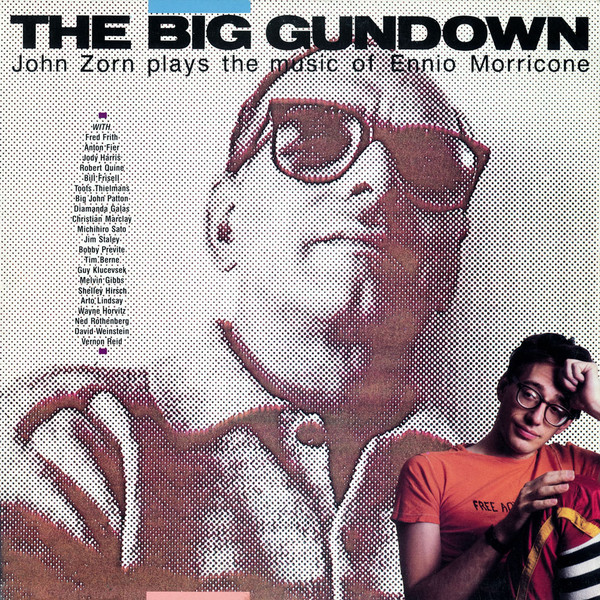
The Big Gundown is the third studio album by American composer and saxophonist/multi-instrumentalist John Zorn. It comprises radically reworked covers of tracks by the Italian film composer Ennio Morricone.
The album is named after a 1966 Spaghetti Western of the same name, directed by Sergio Sollima, starring Lee Van Cleef, and scored by Morricone. The album was first released in 1985 on the Nonesuch/Icon label. In 2000 a remastered 15th Anniversary Edition with additional tracks was released on CD on Zorn's Tzadik Records label.
In 1985 Zorn had been working in New York City's experimental music scene for almost a decade (the album was originally to be called "Once Upon a Time in the Lower East Side"), but The Big Gundown launched him to wider prominence. In the notes for the 2000 reissued CD, Zorn describes The Big Gundown as representing a creative breakthrough as well for being the first time he worked extensively with multitrack recording, overdubbing and ornate orchestration. Though his main instrument is alto sax, Zorn did not play on most tracks, adding only a few touches of piano, game calls, harpsichord or musical saw.
== Reception ==
The AllMusic review by Scott Yanow stated, "There are certainly no dull moments on this often-riotous program". The Penguin Guide to Jazz selected this album as part of its suggested "Core Collection" and awarded it a "crown", calling it "utterly remarkable in every way and one of the essential records of the '80s".
The Rolling Stone review by Steve Futterman was less enthusiastic, and Futterman stated, "Despite high-spirited contributions from a first rate cast, Zorn's tentative and analytical remakes tend to bleed Morricone's high drama and joyous kitschiness dry".
== Track listing ==
"The Big Gundown" – 7:26
"Peur sur la Ville" – 4:16
"Poverty (Once Upon a Time in America)" – 3:49
"Milano Odea" – 3:02
"Erotico (The Burglars)" – 4:27
"Battle of Algiers" – 3:50
"Giu la Testa (Duck You Sucker!)" – 6:06
"Metamorfosi (La Classe Operaia Va In Paradiso)" – 4:37
"Tre nel 5000" – 4:37
"Once Upon a Time in the West" – 8:44
The album was re–released and remastered in 2000, with six newly recorded tracks:
11. "The Sicilian Clan" – 3:20
12. "Macchie Solari" – 3:29
13. "The Ballad of Hank McCain" – 5:27
14. "Svegliatti & Uccidi" – 3:03
15. "Chi Mai" – 3:06
16. "The Ballad of Hank McCain (instrumental)" – 5:28
All compositions by Ennio Morricone except "Tre nel 5000" by John Zorn
== Personnel ==
== References ==
Source: Wikipedia ↗
Biography: John Zorn
John Zorn (born September 2, 1953) is an American composer, conductor, producer, arranger and saxophonist who "deliberately resists category". Zorn's avant-garde compositions and experimental improvisations meld jazz, rock, hardcore, classical, contemporary, surf, metal, soundtrack, ambient, Jewish and world music performed by "often unexpected groups of players.. getting startling, unrepeatable results". Rolling Stone noted that "[alt]hough Zorn has operated almost entirely outside the mainstream, he's gradually asserted himself as one of the most influential musicians of our time".
Zorn re-arranged and radically orchestrated Ennio Morricone's spaghetti Western, gangster and war movie themes for The Big Gundown, released on Nonesuch Records in 1986 to critical acclaim. His following albums, Spillane (1987) and Naked City (1990) continued to merge styles and challenge formats. His alternative hardcore influenced bands, Naked City and Painkiller gained him wider exposure in the early 1990s. From 1994 until 2018, Zorn composed and recorded over three hundred Masada project compositions performed by many different ensembles.
Zorn's extensive recordings have been released through his independent Tzadik Records since 1995. Zorn has composed concert music for classical ensembles and orchestras, for opera, sound installations, film and documentary. His live performances are often highlighted at festivals featuring different ensembles interpreting his diverse repertoire.
== Early life and career ==
=== Early studies ===
John Zorn was raised in Utopia, Queens, and studied piano, guitar and flute at the United Nations International School. Zorn's mother, Vera (née Studenski; 1918–1999), listened to classical and world music; his father, Henry Zorn (1913–1992), was interested in jazz, French chansons, and country music; and his older brother collected doo-wop and 1950s rock and roll records. Zorn spent his teenage years "listening to The Doors and playing bass in a surf band" while also exploring the experimental and avant-garde music of György Ligeti, Mauricio Kagel and Karlheinz Stockhausen and listening to cartoon soundtracks and film scores.
Zorn taught himself orchestration and counterpoint by transcribing scores and studied composition under Leonardo Balada before enrolling at Webster College where he attended lectures by Oliver Lake. While at Webster he incorporated elements of free jazz, avant-garde and experimental music, film scores, performance art and the cartoon scores of Carl Stalling into his first recordings and discovered Anthony Braxton's groundbreaking solo album For Alto which inspired him to take up the instrument. "I'm not going to sit in some ivory tower and pass my scores down to the players", said Zorn, "I have to be there with them, and that's why I started playing saxophone, so that I could meet musicians. I still feel that I have to earn a player's trust before they can play my music."
Leaving Webster after three semesters, Zorn lived on the West Coast before returning to Manhattan where he gave concerts in his apartment and other small New York venues, playing saxophone and a variety of reeds, duck calls, tapes, and other instruments. Zorn immersed himself in the underground art scene, assisting filmmaker Jack Smith with his performances and attending plays by Richard Foreman.
=== Early compositions and recordings ===
In the mid-1970s Zorn was performing experimental downtown music in New York, collaborating with other artists to develop improvisational and compositional strategies he commenced recording by the end of the decade. The 1980s saw him touring internationally and led to further independent releases in Europe and Japan before Zorn established the Tzadik record label in 1995.
Zorn's early major compositions included many game pieces described as "complex systems harnessing improvisers in flexible compositional formats". These compositions "involved strict rules, role playing, prompters with flashcards, all in the name of melding structure and improvisation in a seamless fashion". Zorn's early game pieces had sporting titles like Lacrosse (1976), Hockey (1978), Pool (1979), and Archery (1979), which he recorded and first released on Eugene Chadbourne's Parachute label. His most enduring game piece is Cobra, composed in 1984 and first recorded in 1987 and in subsequent versions in 1992, 1994 and 2002, and revisited in performance many times.
In the early 1980s, Zorn was heavily engaged in improvisation as both a solo performer and with other like-minded artists. Zorn's first solo saxophone recordings were originally released in two volumes as The Classic Guide to Strategy in 1983 and 1986 on the Lumina label. Zorn's early small group improvisations are documented on Locus Solus (1983) which featured Zorn with various combinations of other improvisers including Christian Marclay, Arto Lindsay, Wayne Horvitz, Ikue Mori, and Anton Fier. Ganryu Island featured a series of duets by Zorn with Michihiro Sato on shamisen, which received limited release on the Yukon label in 1984. Zorn has subsequently reissued these early recordings.
=== Breakthrough recordings ===
Zorn's breakthrough came in 1986 with the acclaimed The Big Gundown released on Nonesuch Records. The album was endorsed by composer Ennio Morricone, who said: "This is a record that has fresh, good and intelligent ideas. It is realization on a high level, a work done by a maestro with great science-fantasy and creativity ... Many people have done versions of my pieces, but no one has done them like this".
Zorn followed with Spillane in 1987, his second major-label release, featuring performances by Albert Collins, the Kronos Quartet, and the sprawling title track, an early "file-card" composition. This method of combining composition and improvisation involved Zorn writing descriptions or ideas on file-cards and arranging them to form the piece. Zorn described the process in 2003:
I write in moments, in disparate sound blocks, so I find it convenient to store these events on filing cards so they can be sorted and ordered with minimum effort. Pacing is essential. If you move too fast, people tend to stop hearing the individual moments as complete in themselves and more as elements of a sort of cloud effect ... I worked 10 to 12 hours a day for a week, just orchestrating these file cards. It was an intense process.
Zorn's file-card method of organizing sound blocks into an overall structure largely depended on the musicians he chose, the way they interpreted what was written on the file cards, and their relationship with Zorn who stated "At the end of the day, I want players to say: this was fun—it was a lot of fucking work, and it's one of the hardest things I've ever done, but it was worth the effort."
Three further releases on Nonesuch followed; Spy vs Spy in 1989, Naked City in 1990, and Filmworks 1986–1990 (1992) before Zorn broke with the label.
== Music ==
=== Jazz ===
Zorn's most direct explorations of jazz included a 'memorial' to hard bop composer Sonny Clark, Voodoo in 1986, and the News for Lulu trio featuring Zorn, Bill Frisell and George E. Lewis performing compositions by Clark, Kenny Dorham, Freddie Redd, and Hank Mobley. He recorded Spy vs Spy featuring hardcore punk versions of Ornette Coleman's compositions in 1989. According to Cook, "Zorn's admirers often consider him a masterful bebop alto player, but when he does perform in something approaching that style his playing has little of the tension and none of the relaxation of the great beboppers, often sounding more strangulated than anything".
=== Film music ===
Zorn stated that "After my record The Big Gundown came out I was convinced that a lot of soundtrack work was going to be coming my way". While interest from Hollywood was not forthcoming, eventually independent filmmakers like Sheila McLaughlin and Raúl Ruiz sought his talents. Filmmaker Walter Hill rejected his music for a film to be called Looters. Although Zorn's score did not make the final cut he used the money he received to establish the record label, Tzadik, on which he released Filmworks II: Music for an Untitled Film by Walter Hill in 1995. Zorn also produced a series of commercial soundtracks for the advertising firm Wieden+Kennedy, including one directed by Jean-Luc Godard, a long-term Zorn inspiration. Zorn used his film commissions to record new ensembles like Masada and the Masada String Trio. From the mid-1990s, Zorn composed film music for independent films dealing with BDSM and LGBT culture, documentaries exploring the Jewish experience, and films about outsider artists. In 2013, after releasing 25 volumes in his Filmworks Series, Zorn announced that he would no longer be releasing music for film.
=== Hardcore: Naked City, Painkiller and beyond ===
Zorn established Naked City in 1988 as a "compositional workshop" to test the limitations of a rock band format. Featuring Zorn (saxophone), Bill Frisell (guitars), Fred Frith (bass), Wayne Horvitz (keyboards), Joey Baron (drums), and vocalist Yamatsuka Eye (and later Mike Patton), Naked City blended Zorn's appreciation of hardcore punk and grindcore bands like Agnostic Front and Napalm Death with influences like film music, country or jazz often in a single composition. The band performed pieces by film composers Ennio Morricone, John Barry, Johnny Mandel and Henry Mancini and modern classicists Alexander Scriabin, Claude Debussy, Charles Ives, and Olivier Messiaen and recorded heavy metal and ambient albums.
In 1991, Zorn formed Painkiller with Bill Laswell on bass and Mick Harris on drums. Painkiller's first two releases, Guts of a Virgin (1991) and Buried Secrets (1992), also featured short grindcore and free jazz-inspired compositions. They released their first live album, Rituals: Live in Japan, in 1993, followed by the double CD Execution Ground (1994), which featured longer dub and ambient-styled pieces. A second live album, Talisman: Live in Nagoya, was released in 2002 and the band was featured on Zorn's 50th Birthday Celebration Volume 12 (2005) with Hamid Drake replacing Harris on drums and guest vocalist Mike Patton.
Both bands attracted worldwide interest, particularly in Japan, where Zorn had relocated following a three-month residency in Tokyo.
In 2006, Zorn formed Moonchild with Mike Patton, Trevor Dunn, and Joey Baron as "a compositional challenge, as a song cycle, songs without words" as he decided "I want to work with Patton more; Patton was very hungry to do more work together. ‘OK, so let's start it with just bass, drums, and voice". Rolling Stone said that Moonchild was "a band that, much like Naked City, mutated radically across its lifespan as Zorn kept raising his compositional bar. While it touched on similar extremes as that group... its episodes are more sustained, its structures more conventionally songlike" noting "For the first five of Moonchild's seven albums, released from 2006 through 2014, Patton utilized his full whisper-to-scream range while operating entirely without lyrics".
=== Concert music ===
As Zorn's interest in Naked City waned, he "started hearing classical music in [his] head again." Zorn started working on compositions that drew on chamber music arrangements of strings, percussion and electronic instruments. Elegy, a suite dedicated to Jean Genet, was released in 1992.
The establishment of Tzadik allowed him to release many compositions which he had written over the previous two decades for classical ensembles. Zorn's earliest released classical composition, Christabel (1972) for five flutes, first appeared on Angelus Novus in 1998. He credits the composition of his 1988 string quartet Cat O' Nine Tails (commissioned and released by the Kronos Quartet on Short Stories) to awakening him to the possibilities of writing for classical musicians. This composition also appeared on The String Quartets (1999) and Cartoon S/M (2000) along with variations on "Kol Nidre", inspired by the Jewish prayer of atonement which was written at the same time as the first Masada Book.
Aporias: Requia for Piano and Orchestra (1998) was Zorn's first full-scale orchestral release featuring pianist Stephen Drury, the Hungarian Radio Children's Choir and the American Composers Orchestra conducted by Dennis Russell Davies.
Much of Zorn's classical work is dedicated or inspired by artists who have influenced him:
Duras: Duchamp (1997) contains tributes to Marguerite Duras and Olivier Messiaen
Songs from the Hermetic Theatre (2001) features compositions dedicated to Harry Smith, Joseph Beuys, and Maya Deren
Madness, Love and Mysticism (2001) featured Le Mômo, inspired by Antonin Artaud, and Untitled, dedicated to Joseph Cornell
Chimeras (2001) was based on Arnold Schoenberg's atonal composition, Pierrot Lunaire
Several of Zorn's later concert works drew inspiration from mysticism and the works of Aleister Crowley in particular; Magick (2004) featured a group called the Crowley Quartet. A 2009 performance of the album's centerpiece Necronomicon was described as "... frenetic vortexes of violent, abrasive motion, separated by eerily becalmed, suspenseful sections with moody, even prayerful melodies. The music is sensational and evocative, but never arbitrary; you always sense a guiding hand behind the mayhem".
Later works expanded to include vocal and operatic works; Mysterium released in 2005 featured Frammenti del Sappho for female chorus; Rituals (2005) featured Zorn's opera composed for the Bayreuth Opera Festival in 1998; and La Machine de l'Être composed in 2000, premiered at the New York City Opera in 2011, and recorded for the 2012 album Music and Its Double.
Zorn's concert works have been performed all over the world and he has received commissions from the New York Philharmonic, Brooklyn Philharmonic and BBC Radio 3.
=== Masada books ===
Conversations with Joey Baron led Zorn to explore and embrace Jewish culture. A further file-card composition Kristallnacht (1992) reflected on the Night of Broken Glass that violently and destructively targeted Jews in Germany and Austria in 1938.
Several movements used the Phrygian dominant and Ukrainian Dorian scales common to klezmer music. Zorn set himself the task of writing 100 compositions using the scale within a year.
==== Book One ====
In 1993 Zorn engaged Baron along with Dave Douglas (trumpet) and Greg Cohen (double bass) to provide musical cues for Joe Chappelle's first film Thieves Quartet (later collected on Filmworks III: 1990–1995) and established the first Masada group to perform his recent compositions using the instrumental lineup and improvisational approach of Ornette Coleman's pioneering free jazz quartet.
Within three years, the number of compositions had grown to 205 and became known as the first Masada Book. Zorn explained:
The project for Masada was to create something positive in the Jewish tradition something that maybe takes the idea of Jewish music into the 21st century the way jazz developed from the teens and 1920s into the '40s, the '50s, the '60s and on ... My initial idea was to write a hundred tunes. And then I ended up writing over 200 for the first book and then performed it countless time for years.
In 1996, Zorn released Bar Kokhba featuring Masada compositions recorded by a rotating group of musicians. Two ensembles arose from this album: the Masada String Trio, composed of Greg Cohen (bass), Mark Feldman (violin), and Erik Friedlander (cello); and the Bar Kokhba Sextet which added Marc Ribot (guitar), Cyro Baptista (percussion), and Joey Baron (drums), both of which were featured on 1998's The Circle Maker. The Masada String Trio were also featured on Zorn's Filmworks series, as part of his 50th Birthday Celebration, and released two albums as part of the Book of Angels project, Azazal and Haborym. In 2003, Zorn formed Electric Masada, a band featuring Zorn, Baptista, Baron, and Ribot, along with Trevor Dunn (bass), Ikue Mori (electronics), Jamie Saft (keyboards), and Kenny Wollesen (drums) releasing their debut live album from Zorn's 50th Birthday Concert series and a double live CD recorded in 2004. In 2019, Zorn formed the New Masada Quartet with Julian Lage (guitar), Jorge Roeder (bass), and Kenny Wollesen (drums).
A Tenth Anniversary Series of Masada recordings was released by Zorn beginning in 2003. The series featured five albums of Masada themes including Masada Guitars by Marc Ribot, Bill Frisell, and Tim Sparks; Masada Recital by Mark Feldman and Sylvie Courvoisier; Masada Rock by Rashanim; and two albums featuring various artists, Voices in the Wilderness and The Unknown Masada.
==== Book Two ====
In 2004, Zorn began composing the second Masada Book, The Book of Angels, resulting in an additional 316 compositions. Zorn explained:
After 10 years of performing the first book, I thought "Maybe it'd be nice to write some more tunes." And I wrote 300 more tunes. When I started writing those it was "Let's see if I can write a hundred songs in a month this time." I've been working on these scales and playing these tunes all this time. In the back of my head somewhere are lodged all kinds of new ideas. Let's see if I can come up with 100 tunes in a month instead of in a year. So in the first month, I popped out a hundred tunes; the second month, another hundred; in the third month, a third 100 tunes. I had no idea that was going to happen.
Zorn released thirty-two volumes of Masada Book Two compositions performed by many varied artists. The titles of many Masada Book Two compositions are derived from demonology and Judeo-Christian mythology.
The Masada quartet performed at the Lincoln Center for the Performing Arts in March 2007 for what were billed as their final concerts. Zorn reformed the band as a sextet with Uri Caine and Cyro Baptista in 2009 saying:
I felt like we kind of hit a plateau a little bit with it in 2007 and I said, "Well, maybe the quartet is really done. Maybe we've accomplished what we can accomplish. Maybe it's time to put this to bed." And then I was asked by the Marciac Jazz Festival to put together a slightly larger group. They asked me what if I added a couple of people to Masada and I said, "I can't add anybody to the quartet. The quartet is the quartet, that's what we do." But then I thought, "Well, if I was going to add someone I would probably ask Uri and Cyro." So we tried it at Marciac and it was unbelievable. We didn't even have any rehearsal time. I just passed the charts out and said, "OK, just watch me because I'll be conducting. Let's just do it." And it was one of those magical clicks on the bandstand that sometimes happens. So yeah, this band is taking off again. After 15 years of doing this music, we can still find new things.
Zorn's Masada compositions and associated ensembles have become a central focus of many concerts and festivals and he has established regular 'Masada Marathons' that feature various bands and musicians performing music from the Masada Books.
==== Book Three ====
Zorn completed the third Masada book, titled The Book Beriah, in 2014.
=== The Dreamers ===
Zorn released one of his most popular albums, The Gift, in 2001, which surprised many with its relaxed blend of surf, exotica and world music. On February 29, 2008, at St Ann's Warehouse in Brooklyn, Zorn premiered The Dreamers, which saw a return to the gentle compositions first featured on The Gift and established the band of the same name. The Dreamers released their second album, O'o, in 2009, an album of Zorn's Book of Angels compositions in 2010 and a Christmas album in 2011.
== Other work ==
=== Tzadik Records ===
In 1992, John Zorn curated the Avant subsidiary of the DIW label with jazz producer Kazunori Sugiyama and released several Naked City recordings on the label as well as many other albums featuring Zorn affiliated musicians including Derek Bailey, Dave Douglas, Erik Friedlander, and Marc Ribot.
In 1995, Zorn established the Tzadik label, allowing him to record and release his continually expanding catalog and works by others. Zorn stated "I do feel that it’s a lot easier to keep your head clear from greed if you’re not involved with major corporations. When I was working with Nonesuch for a short period, I got wrapped up with the same shit of like, “Why does Bill Frisell have a bigger budget than me?” I mean like, that's something to think about? I could feel greed growing in me like a cancer. And for me, it's very hard to deal with.."
The label's releases are divided into series:
The Archival Series features Zorn's recordings exclusively, including re-releases of several albums that appeared on other labels, Zorn's film work, and recordings from 1973 onwards;
The 50th Birthday Celebration Series is 11 live albums recorded in September 2003 at Tonic as part of the month-long concert retrospective of Zorn's work;
The Composer Series features Zorn's music for "classical" ensembles along with work by many other contemporary composers;
The Radical Jewish Culture Series features contemporary Jewish musicians;
The New Japan Series covers Japanese underground music;
The Film Music Series features soundtracks by other musicians (Zorn's Filmworks recordings are featured in the Archival Series);
The Oracle Series promotes women in experimental music;
The Key Series presents notable avant-garde musicians and projects;
The Lunatic Fringe Series releases music and musicians operating outside of the broad categories offered by other series; and
The Spotlight Series promotes new bands and musical projects of young musicians.
Tzadik also releases special-edition CDs, DVDs, books and T-shirts. Since 1998, the designs of Tzadik releases have been created by graphic artist Heung-Heung "Chippy" Chin.
=== The Stone (music venue) ===
Zorn's earliest New York performances occurred at small artist-run performance spaces including his own apartment. As his profile grew, he became associated with several Lower East Side alternative venues such as the Knitting Factory and Tonic. On Friday April 13, 2007, Zorn played the final night at Tonic before it closed due to financial pressures.
Zorn was the principal force in establishing The Stone in 2005, an avant-garde performance space in New York's Alphabet City which supports itself solely on donations and the sale of limited-edition CDs, giving all door revenues directly to the performers. Zorn holds the title of artistic director and regularly performs 'Improvisation Nights'. Zorn feels that "The Stone is a unique space and is different from Tonic, the Knitting Factory, and most of the other venues we have played at as there is no bar ... so there is NO pressure to pack the house with an audience that drinks, and what night you perform has nothing to do with your power to draw a crowd or what kind of music you might play". On January 10, 2008, Zorn performed with Lou Reed and Laurie Anderson at a special benefit night at The Stone which was also released on The Stone: Issue Three on CD. In December 2016 Zorn announced that The Stone would close in February 2018 but that he was hopeful that a new location could be found, stating "Venues come and go, but the music continues on forever!" By March 2017 Zorn had negotiated with The New School to move The Stone to Greenwich Village. On February 25, 2018, the last performance was held at the original venue and Zorn moved operations to The New School's The Glass Box Theatre on the basis of a handshake deal.
=== 50th and 60th birthday concert series ===
In September 2003, Zorn celebrated his 50th birthday with a month-long series of performances at Tonic in New York, repeating an event he had begun a decade earlier at the Knitting Factory. He conceptualized the month into several different aspects of his musical output. Zorn's bands performed on the weekends, classical ensembles were featured on Sundays, Zorn performed improvisations with other musicians on Mondays, featured his extended compositions on Tuesdays and a retrospective of game pieces on Wednesdays. A total of 12 live albums were released on his 50th Birthday Celebration Series.
Zorn's 60th birthday celebrations encompassed concerts across the globe from festival appearances to unique events in art galleries and unusual venues across 2013 and into 2014. The first concerts under the Zorn@60 banner were performed at the Walker Art Center in Minneapolis in April 2013. This was followed by performances at the Museum of Modern Art and Solomon R. Guggenheim Museum. The European leg of Zorn@60 commenced at the Barbican Theatre in London in July 2013. Festival appearances in Belgium, Poland, Spain and Germany followed soon after. These were followed by concerts in Victoriaville, Canada. Returning to New York City other concert appearances occurred at Alice Tully Hall and Lincoln Centre.
Zorn undertook another of his celebrated Masada Marathons at the Skirball Center for the Performing Arts in August. Further New York City concerts in September included performances of music for film at the Anthology Film Archives, classical works and Cobra at the Miller Theatre, a day-long concert at the Metropolitan Museum of Art and a performance of improvised duets with Ryuichi Sakamoto. In October, the International Contemporary Ensemble performed a retrospective of Zorn's classical music at the Museum of Contemporary Art, Chicago. The final Zorn@60 concerts were performed as part of the Adelaide Festival in Australia in March 2014 featuring a four concerts covering the breadth of his compositional and improvisational range.
=== Arcana (book series) ===
In 2000, Zorn edited the book Arcana: Musicians on Music featuring interviews, essays, and commentaries by musicians including Anthony Coleman, Peter Garland, David Mahler, Bill Frisell, Gerry Hemingway, George E. Lewis, Fred Frith, Eyvind Kang, Mike Patton and Elliott Sharp, on the compositional process. Zorn released the second volume of Arcana: Musicians on Music in the summer of 2007. According to the preface by Zorn, "This second installment of what will be a continuing series of books presenting radical, cutting-edge ideas about music is made, like the initial volume, out of necessity." New volumes have since been released; the eighth volume was published in September 2017.
=== In other media ===
Zorn also appeared on the 1985 Henry Hills film Money about the financial struggles of Manhattan avant garde artists during the age of Reaganism.
== Awards ==
In 2001, John Zorn received the Jewish Cultural Award in Performing Arts from the National Foundation for Jewish Culture. In 2006, Zorn was named a MacArthur Fellow. In 2007, he was the recipient of Columbia University's School of the Arts William Schuman Award, an honor given "to recognize the lifetime achievement of an American composer whose works have been widely performed and generally acknowledged to be of lasting significance."
In 2011, Zorn was inducted into the Long Island Music Hall of Fame by Lou Reed, and was awarded the Magister Artium Gandensis, an honorary degree from the University of Ghent. In 2014, he received honorary doctorates from The State University of New York and the New England Conservatory of Music.
== Discography ==
== Filmography ==
Money (1985), a "manic collage film" by Henry Hills on "the early days of "language poetry" and the downtown improvised music scene."
Put More Blood Into the Music (1987), documentary by George Atlas on New York avant garde music, aired Sunday March 12, 1989, as episode 292 of The South Bank Show.
Step Across the Border (1990), documentary on Fred Frith.
A Bookshelf on Top of the Sky: 12 Stories About John Zorn (Tzadik, 2004), film portrait by Claudia Heuermann.
Masada Live at Tonic 1999 (2004), concert film.
Celestial Subway Lines / Salvaging Noise (2005), experimental documentary by Ken Jacobs with soundtrack by Zorn and Ikue Mori.
Sabbath in Paradise (Tzadik, 2007), documentary by Claudia Heuermann on Jewish musical culture in New York's avant garde Jazz scene in the 1990s.
Astronome: A Night at the Opera (2010), an opera by Richard Foreman, music by John Zorn.
Zorn I (2016) by Mathieu Amalric
Zorn II (2018) by Mathieu Amalric
Zorn III (2022) by Mathieu Amalric
== Bibliography ==
Zorn, John (editor). Arcana: Musicians on Music. Hips Road: New York 2000, ISBN 1-887123-27-X.
Zorn, John (editor). Arcana II: Musicians on Music. Hips Road/Tzadik: New York 2007, ISBN 0-9788337-6-7.
Zorn, John (editor). Arcana III: Musicians on Music. Hips Road/Tzadik: New York 2008, ISBN 0-9788337-7-5.
Zorn, John (editor). Arcana IV: Musicians on Music. Hips Road/Tzadik: New York 2009, ISBN 0-9788337-8-3.
Zorn, John (editor). Arcana V: Musicians on Music, Magic & Mysticism. Hips Road/Tzadik: New York 2010, ISBN 0-9788337-9-1.
Zorn, John (editor). Arcana VI: Musicians on Music. Hips Road/Tzadik: New York 2012, ISBN 0-9788337-5-9.
Zorn, John (editor). Arcana VII: Musicians on Music. Hips Road/Tzadik: New York 2014, ISBN 0-9788337-4-0.
Zorn, John (editor). Arcana VIII: Musicians on Music. Hips Road/Tzadik: New York 2017, ISBN 0-9788337-3-2.
Zorn, John (editor). Arcana IX: Musicians on Music. Hips Road/Tzadik: New York 2021, ISBN 0-9788337-2-4.
Zorn, John (editor). Arcana X: Musicians on Music. Hips Road/Tzadik: New York 2022, ISBN 0-9788337-1-6.
== References ==
== Further reading ==
Cole Gagne, Soundpieces 2: Interviews with American Composers. Metuchen, N.J.: The Scarecrow Press, 1993. ISBN 0-8108-2710-7
Edward Strickland, American Composers: Dialogues on Contemporary Music. Bloomington: Indiana University Press, 1991. ISBN 0-253-35498-6
NYTimes feature/interview, 2013
John Zorn collected news and commentary at The New York Times
== External links ==
The Stone website
Hips Road Edition: Concert music of John Zorn, including score and mp3 samples
Art of the States: John Zorn
John Zorn at IMDb
John Zorn discography at Discogs
Discography of John Zorn by Patrice Roussel (to June 2013) Archived 2017-10-24 at the Wayback Machine
John Zorn Primer The Wire Issue 156 Feb 1997
John Zorn interview (Hungarian) Archived 2008-02-29 at the Wayback Machine
Brackett, John. John Zorn: Tradition and Transgression. Bloomington: Indiana University Press, 2008. ISBN 978-0-253-22025-7.
John Zorn Q&A Session
Source: Wikipedia ↗
Biography: Ennio Morricone
Ennio Morricone (10 November 1928 – 6 July 2020) was an Italian composer, orchestrator, conductor, trumpeter, and pianist who wrote music in a wide range of styles. With more than 400 scores for cinema and television, as well as more than 100 classical works, Morricone is widely considered one of the most prolific and greatest film composers of all time. He received numerous accolades throughout his career, including two Academy Awards, three Grammy Awards, three Golden Globes, six BAFTAs, ten David di Donatello, eleven Nastro d'Argento, two European Film Awards, the Golden Lion Honorary Award, and the Polar Music Prize.
His filmography includes more than 70 award-winning films, all of Sergio Leone's films from A Fistful of Dollars on, all of Giuseppe Tornatore's films since Cinema Paradiso, Dario Argento's Animal Trilogy, as well as The Battle of Algiers (1966), 1900 (1976), La Cage aux Folles (1978), Le Professionnel (1981), The Thing (1982), The Key (1983) by Tinto Brass and Tie Me Up! Tie Me Down! (1989). He received the Academy Award for Best Original Score nominations for Days of Heaven (1978), The Mission (1986), The Untouchables (1987), Bugsy (1991), Malèna (2000) and The Hateful Eight (2015), winning for the last. He won the Academy Honorary Award in 2007. His score to The Good, the Bad and the Ugly (1966) is regarded as one of the most influential soundtracks in history. It was inducted into the Grammy Hall of Fame in 2008.
After playing the trumpet in jazz bands in the 1940s, Morricone became a studio arranger for RCA Victor and in 1955 started ghost writing for film and theatre. Throughout his career, he composed music for artists such as Paul Anka, Mina, Milva, Zucchero, and Andrea Bocelli. From 1960 to 1975, he gained international fame for composing music for Westerns and—with an estimated 10 million copies sold—Once Upon a Time in the West is one of the best-selling scores worldwide. From 1966 to 1980, he was a main member of Il Gruppo, one of the first experimental composers collectives. In 1969, he co-founded Forum Music Village, a prestigious recording studio. He continued to compose music for European productions, such as Marco Polo, La piovra, Nostromo, Fateless, Karol, and En mai, fais ce qu'il te plait.
Morricone composed for Hollywood directors such as Don Siegel, Mike Nichols, Brian De Palma, Barry Levinson, William Friedkin, Oliver Stone, Warren Beatty, John Carpenter, and Quentin Tarantino. He has also worked with directors such as Bernardo Bertolucci, Mauro Bolognini, Tinto Brass, Giuliano Montaldo, Roland Joffé, Wolfgang Petersen, Roman Polanski, Henri Verneuil, Mario Bava, Lucio Fulci, Umberto Lenzi, Gillo Pontecorvo, and Pier Paolo Pasolini. His best-known compositions include "The Ecstasy of Gold", "Se telefonando", "Man with a Harmonica", "Here's to You", "Chi mai", "Gabriel's Oboe", and "E più ti penso". He has influenced many artists including Hans Zimmer, Danger Mouse, Dire Straits, Muse, Metallica, Fields of the Nephilim, and Radiohead.
On May 10, 2016, Mondadori Libri published his official autobiography, Ennio Morricone. Inseguendo quel suono. La mia musica, la mia vita. Written in conversation with Alessandro De Rosa, the book has been reprinted several times in Italy, translated into the world’s major languages, transcribed and published in English under the title Ennio Morricone: In His Own Words by Oxford University Press in 2019, and described by Morricone himself in the preface as “the best book ever written about me, the most authentic, the most detailed and well curated. The truest.”
== Early life and education ==
Morricone was born in Rome, the son of Libera Ridolfi and Mario Morricone, a musician. At the time of his birth, Italy was under fascist rule. Morricone had four siblings – Adriana, Aldo, Maria, and Franca – and lived in Trastevere in the centre of Rome. His father was a professional trumpeter who performed in light-music orchestras while his mother set up a small textile business. During his early schooldays, Morricone was also a classmate of his later collaborator Sergio Leone.
Morricone's father taught him to read music and to play several instruments. He entered the Saint Cecilia Conservatory to take trumpet lessons under the guidance of Umberto Semproni. He formally entered the conservatory in 1940 at age 12, enrolling in a four-year harmony program that he completed within six months. He studied the trumpet, composition, and choral music under the direction of Goffredo Petrassi, to whom Morricone would later dedicate concert pieces. In 1941, Morricone was chosen among the students of the Saint Cecilia Conservatory to be a part of the Orchestra of the Opera, directed by Carlo Zecchi on the occasion of a tour of the Veneto region. He received his diploma in trumpet in 1946, continuing to work in classical composition and arrangement. Morricone received the Diploma in Instrumentation for Band Arrangement with a mark of 9/10 in 1952. His studies concluded at the Conservatory of Santa Cecilia in 1954 when he obtained a final 9.5/10 in his Diploma in Composition under Petrassi.
== Career ==
=== First compositions ===
Morricone wrote his first compositions when he was six years old, and he was encouraged to develop his natural talents. In 1946, he composed "Il Mattino" ("The Morning") for voice and piano on a text by Fukuko, first in a group of seven "youth" Lieder. In the following years, he continued to write music for the theatre as well as classical music for voice and piano, such as "Imitazione", based on a text by Italian poet Giacomo Leopardi, "Intimità", based on a text by Olinto Dini, "Distacco I" and "Distacco II" with words by R. Gnoli, "Oboe Sommerso" for baritone and five instruments with words by poet Salvatore Quasimodo, and "Verrà la Morte", for alto and piano, based on a text by novelist Cesare Pavese.
In 1953, Morricone was asked by Gorni Kramer and Lelio Luttazzi to write an arrangement for some medleys in an American style for a series of evening radio shows. Many of his orchestral and chamber compositions were written in 1954–1959: Musica per archi e pianoforte (1954), Invenzione, Canone e Ricercare per piano; Sestetto per flauto, oboe, fagotto, violino, viola, e violoncello (1955), Dodici Variazione per oboe, violoncello, e piano; Trio per clarinetto, corno, e violoncello; Variazione su un tema di Frescobaldi (1956); Quattro pezzi per chitarra (1957); Distanze per violino, violoncello, e piano; Musica per undici violini, Tre Studi per flauto, clarinetto, e fagotto (1958); and the Concerto per orchestra (1957), dedicated to his teacher Goffredo Petrassi. Morricone soon gained popularity by writing his first background music for radio dramas and quickly moved into film. Nevertheless, he continued to compose classical music later in his career. In 1995, he was commissioned to write the opera Partenope. The opera was first premiered on December 12, 2025, five years after Morricone's death.
==== Composing for radio, television, and pop artists ====
Morricone's career as an arranger began in 1950, by arranging the piece Mamma Bianca (Narciso Parigi). On occasion of the "Anno Santo" (Holy Year), he arranged a long group of popular songs of devotion for radio broadcasting. In 1956, Morricone started to support his family by playing in a jazz band and arranging pop songs for the Italian broadcasting service RAI. He was hired by RAI in 1958 but quit his job on his first day at work when he was told that broadcasting of music composed by employees was forbidden by a company rule. Subsequently, Morricone became a top studio arranger at RCA Victor, working with Renato Rascel, Rita Pavone, Domenico Modugno, and Mario Lanza.
Throughout his career, Morricone composed songs for several national and international jazz and pop artists, including Gianni Meccia (Il barattolo, 1960), Gianni Morandi (Go Kart Twist, 1962; Non son degno di te, 1964), Alberto Lionello (La donna che vale, 1959), Edoardo Vianello (Ornella, 1960; Cicciona cha-cha, 1960; Faccio finta di dormire, 1961; T'ho conosciuta, 1963; and also Pinne, fucine ed occhiali, I Watussi and Guarda come dondolo), Nora Orlandi (Arianna, 1960), Jimmy Fontana (Twist no. 9; Nicole, 1962), Rita Pavone (Come te non c'e' nessuno and Pel di carota from 1962, arranged by Luis Bacalov), Catherine Spaak (Penso a te; Questi vent'anni miei, 1964), Luigi Tenco (Quello che conta; Tra tanta gente; 1962), Gino Paoli (Nel corso from 1963, written by Morricone with Paoli), Renato Rascel (Scirocco, 1964), Paul Anka (Ogni Volta), Amii Stewart, Rosy Armen (L'Amore Gira), Milva (Ridevi, Metti Una Sera A Cena), Françoise Hardy (Je changerais d'avis, 1966), Mireille Mathieu (Mon ami de toujours; Pas vu, pas pris, 1971; J'oublie la pluie et le soleil, 1974), and Demis Roussos (I Like The World, 1970).
In 1963, the composer co-wrote (with Roby Ferrante) the music for the composition "Ogni volta" ("Every Time"), a song that was performed by Paul Anka for the first time during the Festival di Sanremo in 1964. This song was arranged and conducted by Morricone and sold more than three million copies worldwide, including one million copies in Italy alone. Another success was his composition "Se telefonando". Performed by Mina, it was a track on Studio Uno 66, the 4th studio album by Mina. Morricone's sophisticated arrangement of "Se telefonando" was a combination of melodic trumpet lines, Hal Blaine–style drumming, a string set, a 1960s Europop female choir, and intensive subsonic-sounding trombones. The Italian Hitparade No. 7 song had eight transitions of tonality building tension throughout the chorus. During the following decades, the song was recorded by several performers in Italy and abroad including covers by Françoise Hardy and Iva Zanicchi (1966), Delta V (2005), Vanessa and the O's (2007), and Neil Hannon (2008). Françoise Hardy – Mon amie la rose site in the reader's poll conducted by the newspaper la Repubblica to celebrate Mina's 70th anniversary in 2010, 30,000 voters picked the track as the best song ever recorded by Mina.
In 1987, Morricone co-wrote It Couldn't Happen Here with the Pet Shop Boys. Other compositions for international artists include: La metà di me and Immagina (1988) by Ruggero Raimondi, Libera l'amore (1989) performed by Zucchero, Love Affair (1994) by k.d. lang, Ha fatto un sogno (1997) by Antonello Venditti, Di Più (1997) by Tiziana Tosca Donati, Come un fiume tu (1998), Un Canto (1998) and Conradian (2006) by Andrea Bocelli, Ricordare (1998) and Salmo (2000) by Angelo Branduardi, and My heart and I (2001) by Sting.
==== First film scores ====
After graduation in 1954, Morricone started to write and arrange music as a ghost writer for films credited to already well-known composers, while also arranging for many light music orchestras of the RAI television network, working especially with Armando Trovajoli, Alessandro Cicognini, and Carlo Savina. He occasionally adopted Anglicized pseudonyms, such as Dan Savio and Leo Nichols.
In 1959, Morricone was the conductor (and uncredited co-composer) for Mario Nascimbene's score to Morte di un amico (Death of a Friend), an Italian drama directed by Franco Rossi. In the same year, he composed music for the theatre show Il lieto fine by Luciano Salce. 1961 marked his real film debut with Luciano Salce's The Fascist. In an interview with American composer Fred Karlin, Morricone discussed his beginnings, stating, "My first films were light comedies or costume movies that required simple musical scores that were easily created, a genre that I never completely abandoned even when I went on to much more important films with major directors".
With The Fascist Morricone began a long-running collaboration with Luciano Salce. In 1962, Morricone composed the jazz-influenced score for Salce's comedy Crazy Desire. That year, Morricone also arranged Italian singer Edoardo Vianello's summer hit "Pinne, fucile, e occhiali", a cha-cha song, peppered with added water effects, unusual instrumental sounds and unexpected stops and starts. Morricone wrote works for the concert hall in a more avant-garde style. Some of these have been recorded, such as Ut, a trumpet concerto dedicated to Mauro Maur.
=== The Group and New Consonance ===
From 1964 up to their eventual disbandment in 1980, Morricone was part of Gruppo di Improvvisazione Nuova Consonanza (G.I.N.C.), a group of composers who performed and recorded avant-garde free improvisations. The Rome-based avant-garde ensemble was dedicated to the development of improvisation and new music methods. The ensemble functioned as a laboratory of sorts, working with anti-musical systems and sound techniques in an attempt to redefine the new music ensemble and explore "New Consonance".
Known as "The Group" or "Il Gruppo", they released seven albums across the Deutsche Grammophon, RCA, and Cramps labels: Gruppo di Improvvisazione Nuova Consonanza (1966), The Private Sea of Dreams (1967), Improvisationen (1968), The Feedback (1970), Improvvisazioni a Formazioni Variate (1973), Nuova Consonanza (1975), and Musica su Schemi (1976). Perhaps the most famous of these is their album entitled The Feed-back, which combines free jazz and avant-garde classical music with funk; the album frequently is sampled by hip hop DJs and is considered to be one of the most collectable records in existence, often fetching more than $1,000 at auction.
Morricone played a key role in The Group and was among the core members in its revolving line-up; in addition to serving as their trumpet player, he directed them on many occasions and they can be heard on a large number of his scores. Held in high regard in avant-garde music circles, they are considered to be the first experimental composers collective, their only peers being the British improvisation collective AMM. Their influence can be heard in free improvising ensembles from the European movements including the Evan Parker Electro-Acoustic Ensemble, the Swiss electronic free improvisation group Voice Crack, John Zorn, and in the techniques of modern classical music and avant-garde jazz groups. The ensemble's groundbreaking work informed their work in composition. The ensemble also performed in varying capacities with Morricone, contributing to some of his 1960s and 1970s Italian soundtracks, including A Quiet Place in the Country (1969) and Cold Eyes of Fear (1971).
=== Film music genres ===
==== Comedy ====
Morricone's earliest scores were Italian light comedy and costume pictures, where he learned to write simple, memorable themes. During the 1960s and 1970s he composed the scores for comedies such as Eighteen in the Sun (Diciottenni al sole, 1962), Il Successo (1963), Lina Wertmüller's The Lizards (I basilischi, 1963), Slalom (1965), Menage all'italiana (Menage Italian Style, 1965), How I Learned to Love Women (Come imparai ad amare le donne, 1966), Her Harem (L'harem, 1967), A Fine Pair (Ruba al prossimo tuo, 1968), L'Alibi (1969), This Kind of Love (Questa specie d'amore, 1972), Winged Devils (Forza "G", 1972), and Fiorina la vacca (1972). His best-known scores for comedies includes La Cage aux Folles (1978) and La Cage aux Folles II (1980), both directed by Édouard Molinaro, Il ladrone (The Good Thief, 1980), Georges Lautner's La Cage aux Folles 3: The Wedding (1985), Pedro Almodóvar's Tie Me Up! Tie Me Down! (1990) and Warren Beatty's Bulworth (1998). Morricone never ceased to arrange and write music for comedies. In 2007, he composed a lighthearted score for the Italian romantic comedy Tutte le Donne della mia Vita by Simona Izzo, the director who co-wrote the Morricone-scored religious mini-series Il Papa Buono.
==== Westerns ====
Although his first films were undistinguished, Morricone's arrangement of an American folk song intrigued director and former schoolmate Sergio Leone. Before being associated with Leone, Morricone had already composed some music for less-known western movies such as Gunfight at Red Sands (1963). In 1962, Morricone met American folksinger Peter Tevis, with the two collaborating on a version of Woody Guthrie's "Pastures of Plenty". Tevis is credited with singing the lyrics of Morricone's songs such as "A Gringo Like Me" (from Gunfight at Red Sands) and "Lonesome Billy" (from Bullets Don't Argue). Tevis later recorded a vocal version of A Fistful of Dollars that was not used in the film.
===== Association with Sergio Leone =====
The turning point in Morricone's career took place in 1964, the year in which his third child, Andrea Morricone, who would also become a film composer, was born. Film director and former schoolmate Sergio Leone hired Morricone, and together they created a distinctive score to accompany Leone's different version of the Western, A Fistful of Dollars (1964).
===== Dollars Trilogy =====
Because budget strictures limited Morricone's access to a full orchestra, he used gunshots, cracking whips, whistle, voices, jew's harp, trumpets, and the new Fender electric guitar, instead of orchestral arrangements of Western standards à la John Ford. Morricone used his special effects to punctuate and comically tweak the action—cluing in the audience to the taciturn man's ironic stance.As memorable as Leone's close-ups, harsh violence, and black comedy, Morricone's work helped to expand the musical possibilities of film scoring. Initially, Morricone was billed on the film as Dan Savio, a name they had used on Gunfight at Red Sands to help its appeal on the international market. A Fistful of Dollars came out in Italy in 1964 and was released in America three years later, greatly popularising the so-called Spaghetti Western genre. For the American release, Sergio Leone followed Morricone and Massimo Dallamano's lead and decided to adopt an American-sounding name, Bob Robertson. Over the film's theatrical release, it grossed more than any other Italian film up to that point. The film debuted in the United States in January 1967, where it grossed US$4.5 million for the year. It eventually grossed $14.5 million in its American release, against its budget of US$200,000.
With the score of A Fistful of Dollars, Morricone began his 20-year collaboration with his childhood friend Alessandro Alessandroni and his Cantori Moderni. Alessandroni provided the whistling and the twanging guitar on the film scores, while his Cantori Moderni were a flexible troupe of modern singers. Morricone in particular drew on the solo soprano of the group, Edda Dell'Orso, at the height of her powers "an extraordinary voice at my disposal". The composer subsequently scored Leone's other two Dollars Trilogy (or Man with No Name Trilogy) spaghetti westerns: For a Few Dollars More (1965) and The Good, the Bad, and the Ugly (1966). All three films starred the American actor Clint Eastwood as The Man With No Name and depicted Leone's own intense vision of the mythical West. Morricone commented in 2007: "Some of the music was written before the film, which was unusual. Leone's films were made like that because he wanted the music to be an important part of it; he kept the scenes longer because he did not want the music to end." According to Morricone this explains "why the films are so slow".
Despite the small film budgets, the Dollars Trilogy was a box-office success. The available budget for The Good, the Bad, and the Ugly was about US$1.2 million, but it became the most successful film of the Dollars Trilogy, grossing US$25.1 million in the United States and more than Lire 2.3 billion (1.2 million EUR) in Italy alone. Morricone's score became a major success and sold more than three million copies worldwide. On 14 August 1968 the original score was certified by the RIAA with a golden record for the sale of 500,000 copies in the United States alone. The main theme to The Good, the Bad, and the Ugly, also titled "The Good, the Bad and the Ugly", was a hit in 1968 for Hugo Montenegro, whose rendition was a No. 2 Billboard pop single in the U.S. and a U.K. No.1 single (for four weeks from mid-November that year).
"The Ecstasy of Gold" became one of Morricone's best-known compositions. The opening scene of Jeff Tremaine's Jackass Number Two (2006), in which the cast is chased through a suburban neighbourhood by bulls, is accompanied by this piece. While punk rock band The Ramones used "The Ecstasy of Gold" as a closing theme during their live performances, Metallica uses "The Ecstasy of Gold" as the introductory music for its concerts since 1983. This composition is also included on Metallica's live symphonic album S&M as well as the live album Live Shit: Binge & Purge. An instrumental metal cover by Metallica (with minimal vocals by lead singer James Hetfield) appeared on the 2007 Morricone tribute album We All Love Ennio Morricone. This metal version was nominated for a Grammy Award in the category of Best Rock Instrumental Performance. In 2009, the Grammy Award-winning hip-hop artist Coolio extensively sampled the theme for his song "Change".
===== Once Upon a Time in the West and others =====
Subsequent to the success of the Dollars trilogy, Morricone also composed the scores for Once Upon a Time in the West (1968) and Leone's last credited western film A Fistful of Dynamite (1971), as well as the score for My Name Is Nobody (1973). Morricone's score for Once Upon a Time in the West is one of the best-selling original instrumental scores in the world today, with as many as 10 million copies sold, including one million copies in France, and more than 800,000 copies in the Netherlands.
The collaboration with Leone is considered one of the exemplary collaborations between a director and a composer. Morricone's last score for Leone was for his last film, the gangster drama Once Upon a Time in America (1984). Leone died on 30 April 1989 of a heart attack at the age of 60. Before his death in 1989, Leone was part-way through planning a film on the Siege of Leningrad, set during World War II. By 1989, Leone had been able to acquire US$100 million in financing from independent backers for the war epic. He had convinced Morricone to compose the film score. The project was cancelled when Leone died two days before he was to officially sign on for the film. In early 2003, Italian filmmaker Giuseppe Tornatore announced he would direct a film called Leningrad. The film has yet to go into production and Morricone was cagey as to details on account of Tornatore's superstitious nature.
===== Association with Sergio Corbucci and Sergio Sollima =====
Two years after the start of his collaboration with Sergio Leone, Morricone also started to score music for another Spaghetti Western director, Sergio Corbucci. The composer wrote music for Corbucci's Navajo Joe (1966), The Hellbenders (1967), The Mercenary/The Professional Gun (1968), The Great Silence (1968), Compañeros (1970), Sonny and Jed (1972), and What Am I Doing in the Middle of the Revolution? (1972). In addition, Morricone composed music for the western films by Sergio Sollima, The Big Gundown (with Lee Van Cleef, 1966), Face to Face (1967), and Run, Man, Run (1968), as well as the 1970 crime thriller Violent City (with Charles Bronson) and the poliziottesco film Revolver (1973).
==== Other westerns ====
Other relevant scores for less popular Spaghetti Westerns include Gunfight at Red Sands (1963), Bullets Don't Argue (1964), A Pistol for Ringo (1965), The Return of Ringo (1965), Seven Guns for the MacGregors (1966), The Hills Run Red (1966), Giulio Petroni's Death Rides a Horse (1967) and Tepepa (1968), A Bullet for the General (1967), Guns for San Sebastian (with Charles Bronson and Anthony Quinn, 1968), A Sky Full of Stars for a Roof (1968), The Five Man Army (1969), Don Siegel's Two Mules for Sister Sara (1970), Life Is Tough, Eh Providence? (1972), and Buddy Goes West (1981).
==== Dramas and political movies ====
With Leone's films, Morricone's name had been put firmly on the map. Most of Morricone's film scores of the 1960s were composed outside the Spaghetti Western genre, while still using Alessandroni's team. Their music included the themes for Il Malamondo (1964), Slalom (1965), and Listen, Let's Make Love (1967). In 1968, Morricone reduced his work outside the movie business and wrote scores for 20 films in the same year. The scores included psychedelic accompaniment for Mario Bava's superhero romp Danger: Diabolik (1968).
Morricone collaborated with Marco Bellocchio (Fists in the Pocket, 1965), Gillo Pontecorvo (The Battle of Algiers (1966), and Queimada! (1969) with Marlon Brando), Roberto Faenza (H2S, 1968), Giuliano Montaldo (Sacco e Vanzetti, 1971), Giuseppe Patroni Griffi ('Tis Pity She's a Whore, 1971), Mauro Bolognini (Drama of the Rich, 1974), Umberto Lenzi (Almost Human, 1974), Pier Paolo Pasolini (Salò, or the 120 Days of Sodom, 1975), Bernardo Bertolucci (Novecento, 1976), and Tinto Brass (The Key, 1983 and Senso '45, 2002).
In 1970, Morricone wrote the score for Violent City. That same year, he received his first Nastro d'Argento for the music in Metti una sera a cena (Giuseppe Patroni Griffi, 1969) and his second only a year later for Sacco e Vanzetti (Giuliano Montaldo, 1971), in which he collaborated with the legendary American folk singer and activist Joan Baez. His soundtrack for Sacco e Vanzetti contains another well-known composition by Morricone, the folk song "Here's to You", sung by Baez. For the writing of the lyrics, Baez was inspired by a letter from Bartolomeo Vanzetti: "Father, yes, I am a prisoner / Fear not to relay my crime". The song was later included in movies such as The Life Aquatic with Steve Zissou.
==== Giallo and horror ====
Morricone's eclecticism found its way to films in the horror genre, such as the giallo thrillers of Dario Argento, from The Bird with the Crystal Plumage (1970), The Cat o' Nine Tails (1971), and Four Flies on Grey Velvet (1971) to The Stendhal Syndrome (1996) and The Phantom of the Opera (1998). His other horror scores include Nightmare Castle (1965), A Quiet Place in the Country (1968), The Antichrist (1974), and Night Train Murders (1975). In addition, Morricone composed music for many popular and cult Italian giallo films, such as Unknown Woman (1969), Forbidden Photos of a Lady Above Suspicion (1970), A Lizard in a Woman's Skin (1971), Cold Eyes of Fear (1971), The Fifth Cord (1971), Short Night of Glass Dolls (1971), The Black Belly of the Tarantula (1971) My Dear Killer (1972), What Have You Done to Solange? (1972), Who Saw Her Die? (1972), Spasmo (1974), and Autopsy (1975). In 1977 Morricone scored John Boorman's Exorcist II: The Heretic and Alberto De Martino's apocalyptic horror film Holocaust 2000, starring Kirk Douglas. In 1982 he composed the score for John Carpenter's science fiction horror movie The Thing. Morricone's main theme for the film was reflected in Marco Beltrami's film's score of prequel of the 1982 film, which was released in 2011.
=== Hollywood career ===
The Dollars Trilogy was not released in the United States until 1967, when United Artists, who had already enjoyed success distributing the British-produced James Bond films in the United States, decided to release Sergio Leone's Spaghetti Westerns. The American release gave Morricone an exposure in America, and his film music became quite popular in the United States.
One of Morricone's first contributions to an American director concerned his music for the religious epic film The Bible: In the Beginning... by John Huston. According to Sergio Miceli's book Morricone, la musica, il cinema, Morricone wrote about 15 or 16 minutes of music, which were recorded for a screen test and conducted by Franco Ferrara. At first, Morricone's teacher Goffredo Petrassi had been engaged to write the score for the great big-budget epic, but Huston preferred another composer. RCA Records then proposed Morricone who was under contract with them, but a conflict between the film's producer Dino De Laurentiis and RCA occurred. The producer wanted to have exclusive rights for the soundtrack, while RCA still had the monopoly on Morricone at that time and did not want to release the composer. Subsequently, Morricone's work was rejected because he did not get permission from RCA to work for Dino De Laurentiis alone. The composer reused the parts of his unused score for The Bible: In the Beginning in such films as The Return of Ringo (1965) by Duccio Tessari and Alberto Negrin's The Secret of the Sahara (1987).
Morricone never left Rome to compose his music and never learned to speak English. But given that he always worked in a wide field of composition genres, from "absolute music", which he always produced, to "applied music", working as orchestrator as well as conductor in the recording field, and then as a composer for theatre, radio, and cinema, the impression arises that he never really cared about his standing in the eyes of Hollywood.
==== 1970–1985: From Two Mules to Red Sonja ====
In 1970, Morricone composed the music for Don Siegel's Two Mules for Sister Sara, an American-Mexican western film starring Shirley MacLaine and Clint Eastwood. The same year the composer also delivered the title theme The Men from Shiloh for the American Western television series The Virginian. In 1974–1975, Morricone wrote music for Spazio 1999, an Italian-produced compilation movie made to launch the Italian-British television series Space: 1999, while the original episodes featured music by Barry Gray. A soundtrack album was only released on CD in 2016 and on LP in 2017. In 1975 he scored the George Kennedy revenge thriller The "Human" Factor, which was the final film of director Edward Dmytryk. Two years later, he composed the score for the sequel to William Friedkin's 1973 film The Exorcist, directed by John Boorman: Exorcist II: The Heretic. The horror film was a major disappointment at the box office. The film grossed US$30,749,142 in the United States.
In 1978, the composer worked with Terrence Malick for Days of Heaven starring Richard Gere, for which he earned his first nomination at the Oscars for Best Original Score. Despite the fact that Morricone had produced some of the most popular and widely imitated film music ever written throughout the 1960s and 1970s, Days of Heaven earned him his first Oscar nomination for Best Original Score, with his score up against Jerry Goldsmith's The Boys from Brazil, Dave Grusin's Heaven Can Wait, Giorgio Moroder's Midnight Express (the eventual winner), and John Williams's Superman: The Movie at the Oscar ceremonies in 1979.
==== 1986–2020: From The Mission to The Hateful Eight ====
Association with Roland Joffé
The Mission, directed by Joffé, was about a piece of history considerably more distant, as Spanish Jesuit missionaries see their work undone as a tribe of Paraguayan natives falls within a territorial dispute between the Spanish and Portuguese. At one point the score was one of the world's best-selling film scores, selling over 3 million copies worldwide. Morricone finally received a second Oscar nomination for The Mission. Morricone's original score lost out to Herbie Hancock's coolly arranged jazz on Bertrand Tavernier's Round Midnight. It was considered a surprising win and a controversial one, given that much of the music in the film was pre-existing. Morricone stated the following during a 2001 interview with The Guardian: "I definitely felt that I should have won for The Mission. Especially when you consider that the Oscar winner that year was Round Midnight, which was not an original score. It had a very good arrangement by Herbie Hancock, but it used existing pieces. So there could be no comparison with The Mission. There was a theft!" His score for The Mission was ranked at number 1 in a poll of the all-time greatest film scores. The top 10 list was compiled by 40 film composers such as Michael Giacchino and Carter Burwell. The score is ranked 23rd on the AFI's list of 25 greatest film scores of all time.
==== Association with De Palma and Levinson ====
On three occasions, Brian De Palma worked with Morricone: The Untouchables (1987), the 1989 war drama Casualties of War and the science fiction film Mission to Mars (2000). Morricone's score for The Untouchables resulted in his third nomination for the Academy Award for Best Original Score. In a 2001 interview with The Guardian, Morricone stated that he had good experiences with De Palma: "De Palma is delicious! He respects music, he respects composers. For The Untouchables, everything I proposed to him was fine, but then he wanted a piece that I didn't like at all, and of course, we didn't have an agreement on that. It was something I didn't want to write – a triumphal piece for the police. I think I wrote nine different pieces for this in total and I said, 'Please don't choose the sixth!' because it was the worst. And guess what he chose? The sixth one. But it really suits the movie."
Barry Levinson, another American director, commissioned the composer on two occasions. First, for the crime-drama Bugsy, starring Warren Beatty, which received ten Oscar nominations, winning two for Best Art Direction-Set Decoration (Dennis Gassner and Nancy Haigh) and Best Costume Design. Of Morricone, Levinson said: "He doesn't have a piano in his studio, I always thought that with composers, you sit at the piano, and you try to find the melody. There's no such thing with Morricone. He hears a melody, and he writes it down. He hears the orchestration completely done."
==== Other notable Hollywood scores ====
During his career in Hollywood, Morricone was approached for numerous other projects, including the Gregory Nava drama A Time of Destiny (1988), Frantic by Polish-French director Roman Polanski (1988, starring Harrison Ford), Franco Zeffirelli's 1990 drama film Hamlet (starring Mel Gibson and Glenn Close), the neo-noir crime film State of Grace by Phil Joanou (1990, starring Sean Penn and Ed Harris), Rampage (1992) by William Friedkin, and the romantic drama Love Affair (1994) by Warren Beatty.
==== Association with Quentin Tarantino ====
In 2009, Tarantino originally wanted Morricone to compose the film score for Inglourious Basterds. Morricone was unable to, because the film's sped-up production schedule conflicted with his scoring of Giuseppe Tornatore's Baarìa. However, Tarantino did use eight tracks composed by Morricone in the film, with four of them included on the soundtrack. The tracks came originally from Morricone's scores for The Big Gundown (1966), Revolver (1973) and Allonsanfàn (1974).
In 2012, Morricone composed the song "Ancora Qui" with lyrics by Italian singer Elisa for Tarantino's Django Unchained, a track that appeared together with three existing music tracks composed by Morricone on the soundtrack. "Ancora Qui" was one of the contenders for an Academy Award nomination in the Best Original Song category, but eventually the song was not nominated. On 4 January 2013 Morricone presented Tarantino with a Life Achievement Award at a special ceremony being cast as a continuation of the International Rome Film Festival. In 2014, Morricone was misquoted as claiming that he would "never work" with Tarantino again, and later agreed to write an original film score for Tarantino's The Hateful Eight, which won him an Academy Award in 2016 in the Best Original Score category. His nomination for this film marked him at that time as the second oldest nominee in Academy history, behind Gloria Stuart. Morricone's win marked his first competitive Oscar, and at the age of 87, he became the oldest person at the time to win a competitive Oscar.
=== Composer for Giuseppe Tornatore ===
In 1988, Morricone started an ongoing and very successful collaboration with Italian director Giuseppe Tornatore. His first score for Tornatore was for the drama film Cinema Paradiso. The international version of the film won the Special Jury Prize at the 1989 Cannes Film Festival and the 1989 Best Foreign Language Film Oscar. Morricone received a BAFTA award with his son Andrea, and a David di Donatello for his score. In 2002, the director's cut 173-minute version was released (known in the US as Cinema Paradiso: The New Version). After the success of Cinema Paradiso, the composer wrote the music for all subsequent films by Tornatore: the drama film Everybody's Fine (Stanno Tutti Bene, 1990), A Pure Formality (1994) starring Gérard Depardieu and Roman Polanski, The Star Maker (1995), The Legend of 1900 (1998) starring Tim Roth, the 2000 romantic drama Malèna (which featured Monica Bellucci) and the psychological thriller mystery film La sconosciuta (2006). Morricone also composed the scores for Baarìa (2009), The Best Offer (2013) starring Geoffrey Rush, Jim Sturgess, and Donald Sutherland, and the romantic drama The Correspondence (2015). The composer won several music awards for his scores in Tornatore's movies. Morricone received a fifth Academy Award nomination and a Golden Globe nomination for Malèna. For Legend of 1900, he won a Golden Globe Award for Best Original Score. In September 2021 Tornatore presented out of competition at the 78th Venice International Film Festival a documentary film about Morricone, Ennio.
=== Television series and last works ===
Morricone wrote the score for the Mafia television series La piovra seasons 2 to 10 from 1985 to 2001, including the themes "Droga e sangue" ("Drugs and Blood"), "La Morale", and "L'Immorale". Morricone worked as the conductor of seasons 3 to 5 of the series. He also worked as the music supervisor for the television project La bibbia ("The Bible"). In the late 1990s, he collaborated with his son Andrea on the Ultimo crime dramas, resulting in Ultimo (1998), Ultimo 2 – La sfida (1999), Ultimo 3 – L'infiltrato (2004) and Ultimo 4 – L'occhio del falco (2013). For Canone inverso (2000) based on the music-themed novel of the same name by the Paolo Maurensig, directed by Ricky Tognazzi and starring Hans Matheson, Morricone won Best Score awards in the David di Donatello Awards and Silver Ribbons.
In the 2000s, Morricone continued to compose music for successful television series such as Il Cuore nel Pozzo (2005), Karol: A Man Who Became Pope (2005), La provinciale (2006), Giovanni Falcone (2007), Pane e libertà (2009) and Come Un Delfino 1–2 (2011–2013). Morricone provided the string arrangements on Morrissey's "Dear God Please Help Me" from the album Ringleader of the Tormentors in 2006. In 2008, the composer recorded music for a Lancia commercial, featuring Richard Gere and directed by Harald Zwart (known for directing The Pink Panther 2).
In spring and summer 2010, Morricone worked with Hayley Westenra for a collaboration on her album Paradiso. The album features new songs written by Morricone, as well as some of his best-known film compositions of the last 50 years. Westenra recorded the album with Morricone's orchestra in Rome during the summer of 2010. Since 1995, he composed the music for several advertising campaigns of Dolce & Gabbana. The commercials were directed by Giuseppe Tornatore. In 2013, Morricone collaborated with Italian singer Laura Pausini on a new version of her hit single "La solitudine" for her 20 years anniversary greatest hits album 20 – The Greatest Hits. Morricone composed the music for The Best Offer (2013) by Giuseppe Tornatore.
Morricone wrote the score for Christian Carion's En mai, fais ce qu'il te plait (2015) and the most recent movie by Tornatore: The Correspondence (2016), featuring Jeremy Irons and Olga Kurylenko. In July 2015, Quentin Tarantino announced after the screening of footage of his movie The Hateful Eight at San Diego Comic-Con that Morricone would score the film, the first Western that Morricone scored since 1981. The score was critically acclaimed and won several awards including the Golden Globe Award for Best Original Score and the Academy Award for Best Original Score. In June 2015, Morricone premiered his Missa Papae Francisci (Mass for Pope Francis) at Rome's Chiesa del Gesù with the Orchestra Roma Sinfonietta and choruses from the Accademia Santa Cecilia and the Rome Opera Theater.
== Live performances ==
Before receiving his diplomas in trumpet, composition and instrumentation from the conservatory, Morricone was already active as a trumpet player, often performing in an orchestra that specialised in music written for films. After completing his education at Saint Cecilia, the composer honed his orchestration skills as an arranger for Italian radio and television. In order to support himself, he moved to RCA in the early sixties and entered the front ranks of the Italian recording industry. Since 1964, Morricone was also a founding member of the Rome-based avant-garde ensemble Gruppo di Improvvisazione Nuova Consonanza. During the existence of the group (until 1978), Morricone performed several times with the group as a trumpet player.
To ready his music for live performance, he joined smaller pieces of music together into longer suites. Rather than single pieces, which would require the audience to applaud every few minutes, Morricone thought the best idea was to create a series of suites lasting from 15 to 20 minutes, which form a sort of symphony in various movements – alternating successful pieces with personal favourites. In concert, Morricone normally had 180 to 200 musicians and vocalists under his baton, performing multiple genre-crossing collections of music. Rock, symphonic and traditional indigenous instruments share the stage.
On 20 September 1984, Morricone conducted the Orchestre national des Pays de la Loire at Cinésymphonie '84 ("Première nuit de la musique de film/First night of film music") in the French concert hall Salle Pleyel in Paris. He performed some of his best-known compositions such as Metti una sera a cena, Novecento and The Good, the Bad and the Ugly. Michel Legrand and Georges Delerue performed on the same evening. On 15 October 1987 Morricone gave a concert in front of 12,000 people in the Sportpaleis in Antwerp, Belgium, with the Dutch Metropole Orchestra and the Italian operatic soprano Alide Maria Salvetta. A live-album with a recording of this concert was released in the same year.
On 9 June 2000, Morricone went to the Flanders International Film Festival Ghent to conduct his music together with the National Orchestra of Belgium. During the concert's first part, the screening of The Life and Death of King Richard III (1912) was accompanied by live music by Morricone. It was the very first time that the score was performed live in Europe. The second part of the evening consisted of an anthology of the composer's work. The event took place on the eve of Euro 2000, the European Football Championship in Belgium and the Netherlands.
Morricone performed over 250 concerts as of 2001. The composer started a world tour in 2001, the latter part sponsored by Giorgio Armani, with the Orchestra Roma Sinfonietta, touring London (Barbican 2001; 75th birthday Concerto, Royal Albert Hall 2003 with singer Dulce Pontes), Paris, Verona, and Tokyo. Morricone performed his classic film scores at the Gasteig in Munich in 2004.
He made his North American concert debut on 3 February 2007 at Radio City Music Hall in New York City. The previous evening, Morricone had already presented at the United Nations a concert comprising some of his film themes, as well as the cantata Voci dal silenzio to welcome the new Secretary-General Ban Ki-Moon. A Los Angeles Times review bemoaned the poor acoustics and opined of Morricone: "His stick technique is adequate, but his charisma as a conductor is zero."
On 26 February 2012, Morricone made his Australian concert debut when he conducted the Western Australian Youth Orchestra together with a 100 voice chorus (made up primarily of West Australian Symphony Orchestra chorus members) at the Burswood Theatre (part of Crown Perth in Perth. On 2 March 2012 he conducted the Adelaide Symphony Orchestra at Elder Park, Adelaide, as part of the Adelaide Festival of Arts. On 22 December 2012 Morricone conducted the 85-piece Belgian orchestra "Orkest der Lage Landen" and a 100-piece choir during a two-hour concert in the Sportpaleis in Antwerp.
In November 2013, Morricone began a world tour to coincide with the 50th anniversary of his film music career and performed in locations such as the Crocus City Hall in Moscow, Santiago, Chile, Berlin, Germany (O2 World, Germany), Budapest, Hungary, and Vienna (Stadthalle). Back in June 2014, Morricone had to cancel a US tour in New York (Barclays Center) and Los Angeles (Nokia Theatre LA Live) due to a back procedure on 20 February. Morricone postponed the rest of his world tour. In November 2014, Morricone stated that he would resume his European tour starting from February 2015 along with Dulce Pontes.
== Personal life ==
On 13 October 1956, Morricone married Maria Travia (born 31 December 1932), whom he had met in 1950. Travia wrote lyrics to complement her husband's pieces. Her works include the Latin texts for The Mission. Together, they had four children: Marco (b. 1957), Alessandra (b. 1961), conductor and film composer Andrea (b. 1964) and Giovanni (b. 1966), a filmmaker who lives in New York City. They remained married for 63 years until his death. Morricone lived in Italy his entire life and never desired to live in Hollywood. He described himself as a Christian leftist, stating that he voted for the Christian Democracy (DC) for more than 40 years, and then, after its dissolution in 1994, he approached the centre-left coalition, becoming also a founding member of the Democratic Party (PD) in 2007.
Morricone loved chess, having learned the game when he was 11. Before his musical career took off, he played in club tournaments in Rome in the mid-1950s. His first official tournament was in 1964, where he won a prize in the third category for amateurs. He was even coached by 12-time Italian champion IM Stefano Tatai for a while. Soon, he got too busy for chess, but he would always keep a keen interest in the game and estimated his peak Elo rating to be nearly 1700. Over the years, Morricone played chess with many big names including GMs Garry Kasparov, Anatoly Karpov, Judit Polgar, and Peter Leko. He once held GM Boris Spassky to a draw in a simultaneous competition with 27 players, where Morricone was the last one standing. On 6 July 2020, Morricone died at the Università Campus Bio-Medico in Rome, aged 91, as a result of injuries sustained to his femur during a fall. Following a private funeral in the hospital's chapel, he was entombed in Cimitero Laurentino.
== Influence ==
Morricone influenced many artists from other styles and genres, including Danger Mouse, Dire Straits, Muse, Metallica, Radiohead, and Hans Zimmer. Morricone's influence extends into the realm of pop music. Hugo Montenegro had a hit with a version of the main theme from The Good, the Bad and the Ugly in both the United Kingdom and the United States. This was followed by his album of Morricone's music in 1968. Morricone's film music was also recorded by many artists. John Zorn recorded an album of Morricone's music, The Big Gundown, with Keith Rosenberg in the mid-1980s. Morricone's Sergio Leone Suite of haunting melodies from the scores he composed for several of the films by Sergio Leone, and performed by Morricone, Roma Sinfonietta Orchestra, and Yo-Yo Ma on cello, was recorded by CBS/Sony (93456) and is featured on Classical radio stations such as the Sarasota, Florida, radio station WSMR.
Morricone collaborated with world music artists, such as Portuguese fado singer Dulce Pontes (in 2003 with Focus, an album praised by Paulo Coelho and where his songbook can be sampled) and virtuoso cellist Yo-Yo Ma (in 2004), who both recorded albums of Morricone classics with the Roma Sinfonietta Orchestra and Morricone himself conducting. The album Yo-Yo Ma Plays Ennio Morricone sold more than 130,000 copies in 2004. Metallica has used Morricone's "The Ecstasy of Gold" as an intro at their concerts since 1983 (shock jocks Opie and Anthony also used the song at the start of their XM Satellite Radio and CBS Radio shows.) The San Francisco Symphony Orchestra also played it on Metallica's live albums S&M and S&M2. The theme from A Fistful of Dollars is also used as a concert intro by The Mars Volta.
Morricone inspired the namesake of Morricone Youth, a New York band dedicated to playing music from film and television, founded by musician and radio host Devon E. Levins in 1999. In addition to composers like Lalo Schifrin and Jerry Goldsmith, the band has performed music from a large spectrum of Morricone's film career, ranging from his work in the spaghetti westerns to The Exorcist II, as well as original Morricone-inspired pieces. The Spaghetti Western Orchestra is an Australian tribute band that started in 2004. Radiohead drew inspiration from the recording style of Morricone for their 1997 album OK Computer. Singer and composer Mike Patton was heavily influenced by Morricone's more experimental oeuvre and in 2005 he commissioned a compilation album, Crime and Dissonance, of the lesser-known soundtracks by "E Maestro" that was released on his own Ipecac Recordings label. Gnarls Barkley's hit single "Crazy" (2006) was musically inspired by Morricone.
Muse cites Morricone as an influence for the songs "City of Delusion", "Hoodoo", and "Knights of Cydonia" on their 2006 album Black Holes and Revelations. The band went on to perform the song "Man with a Harmonica" live played by Chris Wolstenholme, as an intro to "Knights of Cydonia". In 2007, the tribute album We All Love Ennio Morricone was released, featuring performances by various artists, including Sarah Brightman, Andrea Bocelli, Celine Dion, Bruce Springsteen and Metallica. Alex Turner has noted Morricone's influence on his writing, in particular on The Last Shadow Puppets album The Age of the Understatement of 2008. "505" samples The Good, the Bad and the Ugly.
"Lovers on the Sun", a song released in 2014 by French music producer David Guetta, is influenced by Morricone's western scores. The Prodigy repurposed Morricone's score from 1966's La resa dei conti (Seconda Caccia) for The Big Gundown on 2009's Invaders Must Die. Anna Calvi has cited Morricone as an influence. Sea Girls' song "Lonely" was written on the day of Morricone's death and is influenced by his music, particularly on the film The Good, the Bad and the Ugly. It was released as a single in February 2022. Sabaton, known for their history based music, based their song on "Audie Murphy (To Hell and Back)" partly on Morricone's style, according to the band's singer.
PJ Harvey has said that Morricone's score for Guns for San Sebastian inspired the song "Telco" from her 1995 album To Bring You My Love.
== Discography ==
Morricone sold well over 70 million records worldwide during his career that spanned over seven decades, including 6.5 million albums and singles in France, over three million in the United States and more than two million albums in South Korea. In 1971, the composer received his first golden record (disco d'oro) for the sale of 1,000,000 records in Italy, and was awarded a "Targa d'Oro" (it) for the worldwide sales of 22 million.
Selected long-time collaborations with directors
== Awards and honours ==
Morricone received his first Academy Award nomination in 1979 for the score to Days of Heaven (Terrence Malick, 1978). He received his second Oscar nomination for The Mission. He also received Oscar nominations for his scores to The Untouchables (1987), Bugsy (1991), Malèna (2000), and The Hateful Eight (2016). In February 2016, Morricone won his first competitive Academy Award for his score to The Hateful Eight. Morricone and Alex North are the only composers to receive the Academy Honorary Award since its introduction in 1928. He received the award in February 2007, "for his magnificent and multifaceted contributions to the art of film music."
In 2005, four film scores by Ennio Morricone were nominated by the American Film Institute for an honoured place in the AFI's Top 25 of Best American Film Scores of All Time. His score for The Mission was ranked 23rd in the Top 25 list. Morricone was nominated seven times for a Grammy Award. In 2009 The Recording Academy inducted his score for The Good, the Bad, and the Ugly (1966) into the Grammy Hall of Fame. In 2010 Ennio Morricone and Icelandic singer Björk won the Polar Music Prize. The Polar Music Prize is Sweden's biggest music award and is typically shared by a pop artist and a classical musician. It was founded by Stig Anderson, manager of Swedish pop group ABBA, in 1989. A Variety poll of 40 top current film composers selected The Mission as the greatest film score of all time.
In 1971, Morricone received a "Targa d'Oro" for worldwide sales of 22 million, and by 2016 Morricone had sold more than 70 million records worldwide. In 2007, he received the Academy Honorary Award "for his magnificent and multifaceted contributions to the art of film music". He was nominated for a further six Oscars, and in 2016, received his only competitive Academy Award for his score to Quentin Tarantino's film The Hateful Eight, at the time becoming the oldest person ever to win a competitive Oscar. His other achievements include three Grammy Awards, three Golden Globes, six BAFTAs, ten David di Donatello, eleven Nastro d'Argento, two European Film Awards, the Golden Lion Honorary Award, and the Polar Music Prize in 2010. The soundtrack for The Mission (1986) was certified gold in the United States. The album Yo-Yo Ma Plays Ennio Morricone stayed for 105 weeks on the Billboard Top Classical Albums.
== Notes ==
== References ==
== Sources ==
Morricone, Ennio; De Rosa, Alessandro. Ennio Morricone: In His Own Words. Ennio Morricone in Conversation with Alessandro De Rosa. Translated from the Italian by M. Corbella. Oxford University Press (2019–2020). ISBN 978-0-19-068103-6.
Horace, B. Music from the Movies, film music journal double issue 45/46, 2005: ISSN 0967-8131.
Miceli, Sergio. Morricone, la musica, il cinema. Milan: Mucchi/Ricordi, 1994: ISBN 978-88-7592-398-3.
Miceli, Sergio. "Morricone, Ennio". The New Grove Dictionary of Music and Musicians, 2nd edition, edited by Stanley Sadie and John Tyrrell. London: Macmillan Publishers.
Poppi, R., M. Pecorari. Dizionario del cinema italiano. I film vol. 3. Dal 1960 al 1969. Gremese, 1993: ISBN 978-88-7605-593-5.
Poppi, R., M. Pecorari. Dizionario del cinema italiano. I film vol. 4. Dal 1970 al 1979* A/L. Gremese, 1996: ISBN 978-88-7605-935-3.
Poppi, R., M. Pecorari. Dizionario del cinema italiano. I film vol. 4. Dal 1970 al 1979** M/Z. Gremese, 1996: ISBN 978-88-7605-969-8.
Poppi, R., M. Pecorari. Dizionario del cinema italiano. I film vol. 5. Dal 1980 al 1989* A/L. Gremese, 2000: ISBN 978-88-7742-423-5.
Poppi, R., M. Pecorari. Dizionario del cinema italiano. I film vol. 5. Dal 1980 al 1989** M/Z. Gremese, 2000: ISBN 978-88-7742-429-7.
== Further reading ==
Fagen, Donald. "A Talk With Ennio Morricone". In: Fagen, Donald: Eminent Hipsters. Penguin Group, 2013. ISBN 978-0-670-02551-0, pp. 59–62.
Lhassa, Anne, and Jean Lhassa: Ennio Morricone: biographie. Les Planches. Lausanne: Favre; [Paris]: [diff. Inter-forum], 1989. ISBN 978-2-8289-0418-0.
Morricone, Ennio; De Rosa, Alessandro. "Ennio Morricone: In His Own Words. Ennio Morricone in conversation with Alessandro De Rosa". Translated from the Italian by M. Corbella. Oxford University Press (2019–2020). ISBN 978-0-19-068103-6
Sorce Keller, Marcello. "The Morricone Paradox: A Film Music Genius Who Missed Writing Symphonies". Asian-European Music Research Journal (AEMR). 6 (2020): 111–113.
Sorbo, Lorenzo: "The Dramatic Functions of Italian Spaghetti Western Soundtracks: A Comparison between Ennio Morricone and Francesco De Masi" In: Stoppe, Sebastian (2014). Film in Concert. Film Scores and their Relation to Classical Concert Music. Glücksstadt, Germany: VWH Verlag. pp. 161–174. doi:10.25969/mediarep/16802. ISBN 978-3-86488-060-5.
Wagner, Thorsten. "Improvisation als 'weiteste Ausdehnung des Begriffs der aleatorischen Musik': Franco Evangelisti und die Improvisationsgruppe Nuova Consonanza". In ... hin zu einer neuen Welt: Notate zu Franco Evangelisti, edited by Harald Muenz.48–60, 2002. Saarbrücken: Pfau-Verlag. ISBN 978-3-89727-177-7.
Webb, Michael D. Italian 20th Century Music: The Quest for Modernity. London: Kahn & Averill. ISBN 978-1-871082-89-0.
Wenguang Han: Ennio Morricone Fans Handbook Archived 26 December 2019 at the Wayback Machine, 2013 (China). ISBN 978-988-16794-2-0
== External links ==
Official website
Ennio Morricone at IMDb
Ennio Morricone discography at Discogs
Tête-à-Tête: Ennio Morricone at the Wayback Machine (archived 27 December 2010)
Morricone Fans at the Wayback Machine (archived 30 July 2013)
Streaming audio of Morricone's "The Man with the Harmonica", from his soundtrack to Once upon a Time in the West
Source: Wikipedia ↗
Elsewhere
Discogs ↗ AllMusic ↗ Rate Your Music ↗
Recent plays
- 8 Oct 2026 · Side 1 · Passolio