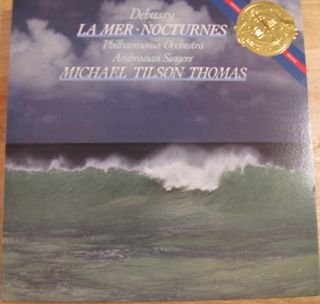
La Mer • Nocturnes
Claude Debussy, London Philharmonic Orchestra, The Ambrosian Singers, Michael Tilson Thomas
1983 · CBS Masterworks · IM 37832 · US
Played once on Passolio by Passolio.
Tracklist
| 1 | De L'Aube A Midi Sur La Mer | |
| 2 | Jeux De Vagues | |
| 3 | Dialogue Du Vent Et Da La Mer | |
| 4 | Nuages | |
| 5 | Fetes | |
| 6 | Sirenes (Ambrosian Singers) |
About this record
Biography: Claude Debussy
Achille Claude Debussy (French: [aʃil klod dəbysi]; 22 August 1862 – 25 March 1918) was a French composer, born in Saint-Germain-en-Laye. He is sometimes seen as the first Impressionist composer, although he vigorously rejected the term. He was among the most influential composers of the late 19th and early 20th centuries.
Born to a family of modest means and little cultural involvement, Debussy showed enough musical talent to be admitted at the age of ten to France's leading music college, the Conservatoire de Paris. He originally studied the piano, but found his vocation in innovative composition, despite the disapproval of the Conservatoire's conservative professors. He took many years to develop his mature style, and was nearly 40 when he achieved international fame in 1902 with the only opera he completed, Pelléas et Mélisande.
Debussy's orchestral works include Prélude à l'après-midi d'un faune (1894), Nocturnes (1897–1899) and Images (1905–1912). His music was to a considerable extent a reaction against Wagner and the German musical tradition. He regarded the classical symphony as obsolete and sought an alternative in his "symphonic sketches", La mer (1903–1905). His piano works include sets of 24 Préludes and 12 Études. Throughout his career he wrote mélodies based on a wide variety of poetry, including his own. He was greatly influenced by the Symbolist poetic movement of the later 19th century. A small number of works, including the early La Damoiselle élue and the late Le Martyre de saint Sébastien have important parts for chorus. In his final years, he focused on chamber music, completing three of six planned sonatas for different combinations of instruments.
With early influences including Russian and Far Eastern music and works by Chopin and Liszt, Debussy developed his own style of harmony and orchestral colouring, derided – and unsuccessfully resisted – by much of the musical establishment of the day. His works have strongly influenced a wide range of composers including Béla Bartók, Igor Stravinsky, George Gershwin, Olivier Messiaen, George Benjamin, and the jazz pianist and composer Bill Evans. Debussy died from cancer at his home in Paris at the age of 55 after a composing career of a little more than 30 years.
== Life and career ==
=== Early life ===
Debussy was born on 22 August 1862 in Saint-Germain-en-Laye, Seine-et-Oise, on the north-west fringes of Paris. He was the eldest of the five children of Manuel-Achille Debussy and his wife, Victorine, née Manoury. Debussy senior ran a china shop and his wife was a seamstress. The shop was unsuccessful and closed in 1864; the family moved to Paris, first living with Victorine's mother, in Clichy, and, from 1868, in their own apartment in the Rue Saint-Honoré. Manuel worked in a printing factory.
In 1870, to escape the siege of Paris during the Franco-Prussian War, Debussy's pregnant mother took him and his sister Adèle to their paternal aunt's home in Cannes, where they remained until the following year. During his stay in Cannes, the seven-year-old Debussy had his first piano lessons; his aunt paid for him to study with an Italian musician, Jean Cerutti. Manuel Debussy remained in Paris and joined the forces of the Commune; after its defeat by French government troops in 1871 he was sentenced to four years' imprisonment, of which he only served one year. His fellow Communard prisoners included his friend Charles de Sivry, a musician. Sivry's mother, Antoinette Mauté de Fleurville, gave piano lessons, and at his instigation the young Debussy became one of her pupils.
Debussy's talents soon became evident, and in 1872, aged ten, he was admitted to the Conservatoire de Paris, where he remained a student for the next eleven years. He first joined the piano class of Antoine François Marmontel, and studied solfège with Albert Lavignac and, later, composition with Ernest Guiraud, harmony with Émile Durand, and organ with César Franck. The course included music history and theory studies with Louis-Albert Bourgault-Ducoudray, but it is not certain that Debussy, who was apt to skip classes, actually attended these.
At the Conservatoire, Debussy initially made good progress. Marmontel said of him, "A charming child, a truly artistic temperament; much can be expected of him". Another teacher was less impressed: Émile Durand wrote in a report, "Debussy would be an excellent pupil if he were less sketchy and less cavalier." A year later he described Debussy as "desperately careless". In July 1874 Debussy received the award of deuxième accessit for his performance as soloist in the first movement of Chopin's Second Piano Concerto at the Conservatoire's annual competition. He was a fine pianist and an outstanding sight reader, who could have had a professional career had he wished, but he was only intermittently diligent in his studies. He advanced to premier accessit in 1875 and second prize in 1877, but failed at the competitions in 1878 and 1879. These failures made him ineligible to continue in the Conservatoire's piano classes, but he remained a student for harmony, solfège and, later, composition.
With Marmontel's help Debussy secured a summer vacation job in 1879 as resident pianist at the Château de Chenonceau, where he rapidly acquired a taste for luxury that was to remain with him all his life. His first compositions date from this period, two settings of poems by Alfred de Musset: "Ballade à la lune" and "Madrid, princesse des Espagnes". The following year he secured a job as pianist in the household of Nadezhda von Meck, the patroness of Tchaikovsky. He travelled with her family for the summers of 1880 to 1882, staying at various places in France, Switzerland and Italy, as well as at her home in Moscow. He composed his Piano Trio in G major for von Meck's ensemble, and made a transcription for piano duet of three dances from Tchaikovsky's Swan Lake.
=== Prix de Rome ===
At the end of 1880 Debussy, while continuing his studies at the Conservatoire, was engaged as accompanist for Marie Moreau-Sainti's singing class; he took this role for four years. Among the members of the class was Marie Vasnier; Debussy was greatly taken with her, and she inspired him to compose: he wrote 27 songs dedicated to her during their seven-year relationship. She was the wife of Henri Vasnier, a prominent civil servant, and much younger than her husband. She soon became Debussy's lover as well as his muse. Whether Vasnier was content to tolerate his wife's affair with the young student or was simply unaware of it is not clear, but he and Debussy remained on excellent terms, and he continued to encourage the composer in his career.
At the Conservatoire, Debussy incurred the disapproval of the faculty, particularly his composition teacher, Guiraud, for his failure to follow the orthodox rules of composition then prevailing. Nevertheless, in 1884 Debussy won France's most prestigious musical award, the Prix de Rome, with his cantata L'enfant prodigue. The Prix carried with it a residence at the Villa Medici, the French Academy in Rome, to further the winner's studies. Debussy was there from January 1885 to March 1887, with three or possibly four absences of several weeks when he returned to France, chiefly to see Marie Vasnier.
Initially Debussy found the artistic atmosphere of the Villa Medici stifling, the company boorish, the food bad, and the accommodation "abominable". Neither did he enjoy Italian opera, as he found the operas of Donizetti and Verdi not to his taste. He was much more impressed by the music of the 16th-century composers Palestrina and Lassus, which he heard at Santa Maria dell'Anima: "The only church music I will accept". He was often depressed and unable to compose, but he was inspired by Franz Liszt, who visited the students and played for them. In June 1885, Debussy wrote of his desire to follow his own way, saying, "I am sure the Institute would not approve, for, naturally it regards the path which it ordains as the only right one. But there is no help for it! I am too enamoured of my freedom, too fond of my own ideas!"
Debussy finally composed four pieces that were submitted to the Academy: the symphonic ode Zuleima (based on a text by Heinrich Heine); the orchestral piece Printemps; the cantata La Damoiselle élue (1887–1888), the first piece in which the stylistic features of his later music began to emerge; and the Fantaisie for piano and orchestra, which was heavily based on Franck's music and was eventually withdrawn by Debussy. The Academy chided him for writing music that was "bizarre, incomprehensible and unperformable". Although Debussy's works showed the influence of Jules Massenet, the latter concluded, "He is an enigma". During his years in Rome Debussy composed – not for the Academy – most of his Verlaine cycle, Ariettes oubliées, which made little impact at the time but was successfully republished in 1903 after the composer had become well known.
=== Return to Paris, 1887 ===
A week after his return to Paris in 1887, Debussy heard the first act of Wagner's Tristan und Isolde at the Concerts Lamoureux and judged it "decidedly the finest thing I know". In 1888 and 1889 he went to the annual festivals of Wagner's operas at Bayreuth. He responded positively to Wagner's sensuousness, mastery of form, and striking harmonies, and was briefly influenced by them, but, unlike some other French composers of his generation, he concluded that there was no future in attempting to adopt and develop Wagner's style. He commented in 1903 that Wagner was "a beautiful sunset that was mistaken for a dawn".
In 1889, at the Paris Exposition Universelle, Debussy first heard Javanese gamelan music. The gamelan scales, melodies, rhythms, and ensemble textures appealed to him, and echoes of them are heard in "Pagodes" in his piano suite Estampes. He also attended two concerts of Rimsky-Korsakov's music, conducted by the composer. This too made an impression on him, and its harmonic freedom and non-Teutonic tone colours influenced his own developing musical style.
Marie Vasnier ended her liaison with Debussy soon after his final return from Rome, although they remained on good enough terms for him to dedicate to her one more song, "Mandoline", in 1890. Later in 1890 Debussy met Erik Satie, who proved a kindred spirit in his experimental approach to composition. Both were bohemians, enjoying the same café society and struggling to survive financially. In the same year Debussy began a relationship with Gabrielle (Gaby) Dupont, a tailor's daughter from Lisieux; in July 1893 they began living together.
Debussy continued to compose songs, piano pieces and other works, some of which were publicly performed, but his music made only a modest impact, although his fellow composers recognised his potential by electing him to the committee of the Société Nationale de Musique in 1893. His String Quartet was premiered by the Ysaÿe string quartet at the Société Nationale in the same year. In May 1893 Debussy attended a theatrical event that was of key importance to his later career – the premiere of Maurice Maeterlinck's play Pelléas et Mélisande, which he immediately determined to turn into an opera. He travelled to Maeterlinck's home in Ghent in November to secure his consent to an operatic adaptation.
=== 1894–1902: Pelléas et Mélisande ===
In February 1894 Debussy completed the first draft of Act I of his operatic version of Pelléas et Mélisande, and for most of the year worked to complete it. While still living with Dupont, he had an affair with the singer Thérèse Roger, and in 1894 he announced their engagement. His behaviour was widely condemned; anonymous letters circulated denouncing his treatment of both women, as well as his financial irresponsibility and debts. The engagement was broken off, and several of Debussy's friends and supporters disowned him, including Ernest Chausson, hitherto one of his strongest supporters.
In terms of musical recognition, Debussy made a step forward in December 1894, when the symphonic poem Prélude à l'après-midi d'un faune, based on Stéphane Mallarmé's poem of the same name, was premiered at a concert of the Société Nationale. The following year he completed the first draft of Pelléas and began efforts to get it staged. In May 1898 he made his first contacts with André Messager and Albert Carré, respectively the musical director and general manager of the Opéra-Comique, Paris, about presenting the opera.
Debussy abandoned Dupont for her friend Marie-Rosalie Texier, known as "Lilly", whom he married in October 1899, after threatening suicide if she refused him. She was affectionate, practical, straightforward, and well liked by Debussy's friends and associates, but he became increasingly irritated by her intellectual limitations and lack of musical sensitivity. The marriage lasted barely five years.
From around 1900 Debussy's music became a focus and inspiration for an informal group of innovative young artists, poets, critics, and musicians who began meeting in Paris. They called themselves Les Apaches – roughly "The Hooligans" – to represent their status as "artistic outcasts". The membership was fluid, but at various times included Maurice Ravel, Ricardo Viñes, Igor Stravinsky and Manuel de Falla. In the same year the first two of Debussy's three orchestral Nocturnes were first performed. Although they did not make any great impact with the public they were well reviewed by musicians including Paul Dukas, Alfred Bruneau and Pierre de Bréville. The complete set was given the following year.
Like many other composers of the time, Debussy supplemented his income by teaching and writing. For most of 1901 he had a sideline as music critic of La Revue Blanche, adopting the pen name "Monsieur Croche". He expressed trenchant views on composers ("I hate sentimentality – his name is Camille Saint-Saëns"), institutions (on the Paris Opéra: "A stranger would take it for a railway station, and, once inside, would mistake it for a Turkish bath"), conductors ("Nikisch is a unique virtuoso, so much so that his virtuosity seems to make him forget the claims of good taste"), musical politics ("The English actually think that a musician can manage an opera house successfully!"), and audiences ("their almost drugged expression of boredom, indifference and even stupidity"). He later collected his criticisms with a view to their publication as a book; it was published posthumously as Monsieur Croche, Antidilettante.
In January 1902 rehearsals began at the Opéra-Comique for the opening of Pelléas et Mélisande. For three months, Debussy attended rehearsals practically every day. In February there was conflict between Maeterlinck on the one hand and Debussy, Messager and Carré on the other about the casting of Mélisande. Maeterlinck wanted his mistress, Georgette Leblanc, to sing the role, and was incensed when she was passed over in favour of the Scottish soprano Mary Garden. The opera opened on 30 April 1902, and although the first-night audience was divided between admirers and sceptics, the work quickly became a success. It made Debussy a well-known name in France and abroad; The Times commented that the opera had "provoked more discussion than any work of modern times, excepting, of course, those of Richard Strauss". The Apaches, led by Ravel (who attended every one of the 14 performances in the first run), were loud in their support; the conservative faculty of the Conservatoire tried in vain to stop its students from seeing the opera. The vocal score was published in early May, and the full orchestral score in 1904.
=== 1903–1918 ===
In 1903 there was public recognition of Debussy's stature when he was appointed a Chevalier of the Légion d'honneur, but his social standing suffered a great blow when another turn in his private life caused a scandal the following year. One of his pupils was Raoul Bardac, son of Emma and her husband, Parisian banker Sigismond Bardac. Raoul introduced his teacher to his mother, to whom Debussy quickly became greatly attracted. She was sophisticated, a brilliant conversationalist, an accomplished singer, and relaxed about marital fidelity, having been the mistress and muse of Gabriel Fauré a few years earlier. After despatching Lilly to her parental home at Bichain in Villeneuve-la-Guyard on 15 July 1904, Debussy took Emma away, staying incognito in Jersey and then at Pourville in Normandy. He wrote to his wife on 11 August from Dieppe, telling her that their marriage was over, but still making no mention of Bardac. When he returned to Paris he set up home on his own, taking a flat in a different arrondissement. On 14 October, five days before their fifth wedding anniversary, Lilly Debussy attempted suicide, shooting herself in the chest with a revolver; she survived, although the bullet remained lodged in her vertebrae for the rest of her life. The ensuing scandal caused Bardac's family to disown her, and Debussy lost many good friends including Dukas and Messager. His relations with Ravel, never close, were exacerbated when the latter joined other former friends of Debussy in contributing to a fund to support the deserted Lilly.
The Bardacs divorced in May 1905. Finding the hostility in Paris intolerable, Debussy and Emma (now pregnant) went to England. They stayed at the Grand Hotel, Eastbourne in July and August, where Debussy corrected the proofs of his symphonic sketches La mer, celebrating his divorce on 2 August. After a brief visit to London, the couple returned to Paris in September, buying a house in a courtyard development off the Avenue du Bois de Boulogne (now Avenue Foch), Debussy's home for the rest of his life.
In October 1905 La mer, Debussy's most substantial orchestral work, was premiered in Paris by the Orchestre Lamoureux under the direction of Camille Chevillard; the reception was mixed. Some praised the work, but Pierre Lalo, critic of Le Temps, hitherto an admirer of Debussy, wrote, "I do not hear, I do not see, I do not smell the sea". In the same month the composer's only child was born at their home. Claude-Emma, affectionately known as "Chouchou", was a musical inspiration to the composer (she was the dedicatee of his Children's Corner suite). She outlived her father by scarcely a year, succumbing to the diphtheria epidemic of 1919. Mary Garden said, "I honestly don't know if Debussy ever loved anybody really. He loved his music – and perhaps himself. I think he was wrapped up in his genius", but biographers are agreed that whatever his relations with lovers and friends, Debussy was devoted to his daughter.
Debussy and Emma Bardac eventually married in 1908, their troubled union enduring for the rest of his life. The following year began well, when at Fauré's invitation, Debussy became a member of the governing council of the Conservatoire. His success in London was consolidated in April 1909, when he conducted Prélude à l'après-midi d'un faune and the Nocturnes at the Queen's Hall; in May he was present at the first London production of Pelléas et Mélisande, at Covent Garden. In the same year, Debussy was diagnosed with colorectal cancer, from which he was to die nine years later.
Debussy's works began to feature increasingly in concert programmes at home and overseas. In 1910 Gustav Mahler conducted the Nocturnes and Prélude à l'après-midi d'un faune in New York in successive months. In the same year, visiting Budapest, Debussy commented that his works were better known there than in Paris. In 1912 Sergei Diaghilev commissioned a new ballet score, Jeux. That, and the three Images, premiered the following year, were the composer's last orchestral works. Jeux was unfortunate in its timing: two weeks after the premiere, in March 1913, Diaghilev presented the first performance of Stravinsky's The Rite of Spring, a sensational event that monopolised discussion in musical circles, and effectively sidelined Jeux along with Fauré's Pénélope, which had opened a week before.
In 1915 Debussy underwent one of the earliest colostomy operations. It achieved only a temporary respite, and occasioned him considerable frustration ("There are mornings when the effort of dressing seems like one of the twelve labours of Hercules"). He also had a fierce enemy at this period in the form of Camille Saint-Saëns, who in a letter to Fauré condemned Debussy's En blanc et noir: "It's incredible, and the door of the Institut [de France] must at all costs be barred against a man capable of such atrocities". Saint-Saëns had been a member of the Institut since 1881: Debussy never became one. His health continued to decline; he gave his final concert on 14 September 1917 and became bedridden in early 1918.
Debussy died of colon cancer on 25 March 1918 at his home, aged 55. The First World War was still raging and Paris was under German aerial and artillery bombardment. The military situation did not permit the honour of a public funeral with ceremonious graveside orations. The funeral procession made its way through deserted streets to a temporary grave at Père Lachaise Cemetery as the German guns bombarded the city. Debussy's body was reinterred the following year in the small Passy Cemetery sequestered behind the Trocadéro, fulfilling his wish to rest "among the trees and the birds"; his wife and daughter are buried with him.
== Works ==
In a survey of Debussy's oeuvre shortly after the composer's death, the critic Ernest Newman wrote, "It would be hardly too much to say that Debussy spent a third of his life in the discovery of himself, a third in the free and happy realisation of himself, and the final third in the partial, painful loss of himself". Later commentators have rated some of the late works more highly than Newman and other contemporaries did, but much of the music for which Debussy is best known is from the middle years of his career.
The analyst David Cox wrote in 1974 that Debussy, admiring Wagner's attempts to combine all the creative arts, "created a new, instinctive, dreamlike world of music, lyrical and pantheistic, contemplative and objective – a kind of art, in fact, which seemed to reach out into all aspects of experience". In 1988 the composer and scholar Wilfrid Mellers wrote of Debussy:
Because of, rather than in spite of, his preoccupation with chords in themselves, he deprived music of the sense of harmonic progression, broke down three centuries' dominance of harmonic tonality, and showed how the melodic conceptions of tonality typical of primitive folk-music and of medieval music might be relevant to the twentieth century
Debussy did not give his works opus numbers, apart from his String Quartet, Op. 10 in G minor (also the only work where the composer's title included a key). His works were catalogued and indexed by the musicologist François Lesure in 1977 (revised in 2003) and their Lesure number ("L" followed by a number) is sometimes used as a suffix to their title in concert programmes and recordings.
=== Early works, 1879–1892 ===
Debussy's musical development was slow, and as a student he was adept enough to produce for his teachers at the Conservatoire works that would conform to their conservative precepts. His friend Georges Jean-Aubry commented that Debussy "admirably imitated Massenet's melodic turns of phrase" in the cantata L'enfant prodigue (1884) which won him the Prix de Rome. A more characteristically Debussian work from his early years is La Damoiselle élue, recasting the traditional form for oratorios and cantatas, using a chamber orchestra and a small body of choral tone and using new or long-neglected scales and harmonies. His early mélodies, inspired by Marie Vasnier, are more virtuosic in character than his later works in the genre, with extensive wordless vocalise; from the Ariettes oubliées (1885–1887) onwards he developed a more restrained style. He wrote his own poems for the Proses lyriques (1892–1893) but, in the view of the musical scholar Robert Orledge, "his literary talents were not on a par with his musical imagination".
The musicologist Jacques-Gabriel Prod'homme wrote that, together with La Demoiselle élue, the Ariettes oubliées and the Cinq poèmes de Charles Baudelaire (1889) show "the new, strange way which the young musician will hereafter follow". Newman concurred: "There is a good deal of Wagner, especially of Tristan, in the idiom. But the work as a whole is distinctive, and the first in which we get a hint of the Debussy we were to know later – the lover of vague outlines, of half-lights, of mysterious consonances and dissonances of colour, the apostle of languor, the exclusivist in thought and in style." During the next few years Debussy developed his personal style, without, at this stage, breaking sharply away from French musical traditions. Much of his music from this period is on a small scale, such as the Two Arabesques, Valse romantique, Suite bergamasque, and the first set of Fêtes galantes. Newman remarked that, like Chopin, the Debussy of this period appears as a liberator from Germanic styles of composition – offering instead "an exquisite, pellucid style" capable of conveying "not only gaiety and whimsicality but emotion of a deeper sort". In a 2004 study, Mark DeVoto comments that Debussy's early works are harmonically no more adventurous than existing music by Fauré; in a 2007 book about the piano works, Margery Halford observes that Two Arabesques (1888–1891) and "Rêverie" (1890) have "the fluidity and warmth of Debussy's later style" but are not harmonically innovative. Halford cites the popular "Clair de Lune" (1890), the third of the four movements of Suite Bergamasque, as a transitional work pointing towards the composer's mature style.
=== Middle works, 1893–1905 ===
Musicians from Debussy's time onwards have regarded Prélude à l'après-midi d'un faune (1894) as his first orchestral masterpiece. Newman considered it "completely original in idea, absolutely personal in style, and logical and coherent from first to last, without a superfluous bar or even a superfluous note"; Pierre Boulez observed, "Modern music was awakened by Prélude à l'après-midi d'un faune". Most of the major works for which Debussy is best known were written between the mid-1890s and the mid-1900s. They include the String Quartet (1893), Pelléas et Mélisande (1893–1902), the Nocturnes for Orchestra (1899) and La mer (1903–1905). The suite Pour le piano (1894–1901) is, in Halford's view, one of the first examples of the mature Debussy as a composer for the piano: "a major landmark ... and an enlargement of the use of piano sonorities".
In the String Quartet (1893), the gamelan sonorities Debussy had heard four years earlier are recalled in the pizzicatos and cross-rhythms of the scherzo. Debussy's biographer Edward Lockspeiser comments that this movement shows the composer's rejection of "the traditional dictum that string instruments should be predominantly lyrical". The work influenced Ravel, whose own String Quartet, written ten years later, has noticeably Debussian features. The academic and journalist Stephen Walsh calls Pelléas et Mélisande (begun 1893, staged 1902) "a key work for the 20th century". The composer Olivier Messiaen was fascinated by its "extraordinary harmonic qualities and ... transparent instrumental texture". The opera is composed in what Alan Blyth describes as a sustained and heightened recitative style, with "sensuous, intimate" vocal lines. It influenced composers as different as Stravinsky and Puccini.
Orledge describes the Nocturnes as exceptionally varied in texture, "ranging from the Musorgskian start of 'Nuages', through the approaching brass band procession in 'Fêtes', to the wordless female chorus in 'Sirènes'". Orledge considers the last a pre-echo of the marine textures of La mer. Estampes for piano (1903) gives impressions of exotic locations, with further echoes of the gamelan in its pentatonic structures. Debussy believed that since Beethoven, the traditional symphonic form had become formulaic, repetitive and obsolete. The three-part, cyclic symphony by César Franck (1888) was more to his liking, and its influence can be found in La mer (1905); this uses a quasi-symphonic form, its three sections making up a giant sonata-form movement with, as Orledge observes, a cyclic theme, in the manner of Franck. The central "Jeux de vagues" section has the function of a symphonic development section leading into the final "Dialogue du vent et de la mer", "a powerful essay in orchestral colour and sonority" (Orledge) which reworks themes from the first movement. The reviews were sharply divided. Some critics thought the treatment less subtle and less mysterious than his previous works, and even a step backward; others praised its "power and charm", its "extraordinary verve and brilliant fantasy", and its strong colours and definite lines.
=== Late works, 1906–1917 ===
Of the later orchestral works, Images (1905–1912) is better known than Jeux (1913). The former follows the tripartite form established in the Nocturnes and La mer, but differs in employing traditional British and French folk tunes, and in making the central movement, "Ibéria", far longer than the outer ones, and subdividing it into three parts, all inspired by scenes from Spanish life. Although considering Images "the pinnacle of Debussy's achievement as a composer for orchestra", Trezise notes a contrary view that the accolade belongs to the ballet score Jeux. The latter failed as a ballet because of what Jann Pasler describes as a banal scenario, and the score was neglected for some years. Recent analysts have found it a link between traditional continuity and thematic growth within a score and the desire to create discontinuity in a way mirrored in later 20th century music. In this piece, Debussy abandoned the whole-tone scale he had often favoured previously in favour of the octatonic scale with what the Debussy scholar François Lesure describes as its tonal ambiguities.
Among the late piano works are two books of Préludes (1909–10, 1911–13), short pieces that depict a wide range of subjects. Lesure comments that they range from the frolics of minstrels at Eastbourne in 1905 and the American acrobat "General Lavine" "to dead leaves and the sounds and scents of the evening air". En blanc et noir (In white and black, 1915), a three-movement work for two pianos, is a predominantly sombre piece, reflecting the war and national danger. The Études (1915) for piano have divided opinion. Writing soon after Debussy's death, Newman found them laboured – "a strange last chapter in a great artist's life"; Lesure, writing eighty years later, rates them among Debussy's greatest late works: "Behind a pedagogic exterior, these 12 pieces explore abstract intervals, or – in the last five – the sonorities and timbres peculiar to the piano." In 1914 Debussy started work on a planned set of six sonatas for various instruments. His fatal illness prevented him from completing the set, but those for cello and piano (1915), flute, viola and harp (1915), and violin and piano (1917 – his last completed work) are all concise, three-movement pieces, more diatonic in nature than some of his other late works.
Le Martyre de saint Sébastien (1911), originally a five-act musical play to a text by Gabriele D'Annunzio that took nearly five hours in performance, was not a success, and the music is now more often heard in a concert (or studio) adaptation with narrator, or as an orchestral suite of "Fragments symphoniques". Debussy enlisted the help of André Caplet in orchestrating and arranging the score. Two late stage works, the ballets Khamma (1912) and La boîte à joujoux (1913), were left with the orchestration incomplete, and were completed by Charles Koechlin and Caplet, respectively.
== Style ==
=== Debussy and Impressionism ===
The application of the term "Impressionist" to Debussy and the music he influenced has been much debated, both during his lifetime and since. The analyst Richard Langham Smith writes that Impressionism was originally a term coined to describe a style of late 19th-century French painting, typically scenes suffused with reflected light in which the emphasis is on the overall impression rather than outline or clarity of detail, as in works by Monet, Pissarro, Renoir and others. Langham Smith writes that the term became transferred to the compositions of Debussy and others which were "concerned with the representation of landscape or natural phenomena, particularly the water and light imagery dear to Impressionists, through subtle textures suffused with instrumental colour".
Among painters, Debussy particularly admired Turner, but also drew inspiration from Whistler. With the latter in mind the composer wrote to the violinist Eugène Ysaÿe in 1894 describing the orchestral Nocturnes as "an experiment in the different combinations that can be obtained from one colour – what a study in grey would be in painting."
Debussy strongly objected to the use of the word "Impressionism" for his (or anybody else's) music, but it has continually been attached to him since the assessors at the Conservatoire first applied it, opprobriously, to his early work Printemps. Langham Smith comments that Debussy wrote many piano pieces with titles evocative of nature – "Reflets dans l'eau" (1905), "Les Sons et les parfums tournent dans l'air du soir" (1910) and "Brouillards" (1913) – and suggests that the Impressionist painters' use of brush-strokes and dots is paralleled in the music of Debussy. Although Debussy said that anyone using the term (whether about painting or music) was an imbecile, some Debussy scholars have taken a less absolutist line. Lockspeiser calls La mer "the greatest example of an orchestral Impressionist work", and more recently in The Cambridge Companion to Debussy Nigel Simeone comments, "It does not seem unduly far-fetched to see a parallel in Monet's seascapes".
In this context may be placed Debussy's pantheistic eulogy to Nature, in a 1911 interview with Henry Malherbe:
I have made mysterious Nature my religion ... When I gaze at a sunset sky and spend hours contemplating its marvellous ever-changing beauty, an extraordinary emotion overwhelms me. Nature in all its vastness is truthfully reflected in my sincere though feeble soul. Around me are the trees stretching up their branches to the skies, the perfumed flowers gladdening the meadow, the gentle grass-carpeted earth, ... and my hands unconsciously assume an attitude of adoration.
In contrast to the "impressionistic" characterisation of Debussy's music, several writers have suggested that he structured at least some of his music on rigorous mathematical lines. In 1983 the pianist and scholar Roy Howat published a book contending that certain of Debussy's works are proportioned using mathematical models, even while using an apparent classical structure such as sonata form. Howat suggests that some of Debussy's pieces can be divided into sections that reflect the golden ratio, which is approximated by ratios of consecutive numbers in the Fibonacci sequence. Simon Trezise, in his 1994 book Debussy: La Mer, finds the intrinsic evidence "remarkable", with the caveat that no written or reported evidence suggests that Debussy deliberately sought such proportions. Lesure takes a similar view, endorsing Howat's conclusions while not taking a view on Debussy's conscious intentions.
=== Musical idiom ===
Debussy wrote "We must agree that the beauty of a work of art will always remain a mystery [...] we can never be absolutely sure 'how it's made.' We must at all costs preserve this magic which is peculiar to music and to which music, by its nature, is of all the arts the most receptive."
Nevertheless, there are many indicators of the sources and elements of Debussy's idiom. Writing in 1958, the critic Rudolph Reti summarised six features of Debussy's music, which he asserted "established a new concept of tonality in European music": the frequent use of lengthy pedal points – "not merely bass pedals in the actual sense of the term, but sustained 'pedals' in any voice"; glittering passages and webs of figurations which distract from occasional absence of tonality; frequent use of parallel chords which are "in essence not harmonies at all, but rather 'chordal melodies', enriched unisons", described by some writers as non-functional harmonies; bitonality, or at least bitonal chords; use of the whole-tone and pentatonic scales; and unprepared modulations, "without any harmonic bridge". Reti concludes that Debussy's achievement was the synthesis of monophonic based "melodic tonality" with harmonies, albeit different from those of "harmonic tonality".
In 1889, Debussy held conversations with his former teacher Guiraud, which included exploration of harmonic possibilities at the piano. The discussion, and Debussy's chordal keyboard improvisations, were noted by a younger pupil of Guiraud, Maurice Emmanuel. The chord sequences played by Debussy include some of the elements identified by Reti. They may also indicate the influence on Debussy of Satie's 1887 Trois Sarabandes. A further improvisation by Debussy during this conversation included a sequence of whole tone harmonies which may have been inspired by the music of Glinka or Rimsky-Korsakov which was becoming known in Paris at this time. During the conversation, Debussy told Guiraud, "There is no theory. You have only to listen. Pleasure is the law!" – although he also conceded, "I feel free because I have been through the mill, and I don't write in the fugal style because I know it."
== Influences ==
=== Musical ===
Among French predecessors, Chabrier was an important influence on Debussy (as he was on Ravel and Poulenc); Howat has written that Chabrier's piano music such as "Sous-bois" and "Mauresque" in the Pièces pittoresques explored new sound-worlds of which Debussy made effective use 30 years later. Lesure finds traces of Gounod and Massenet in some of Debussy's early songs, and remarks that it may have been from the Russians – Tchaikovsky, Balakirev, Rimsky-Korsakov, Borodin and Mussorgsky – that Debussy acquired his taste for "ancient and oriental modes and for vivid colorations, and a certain disdain for academic rules". Lesure also considers that Mussorgsky's opera Boris Godunov directly influenced Debussy's Pelléas et Mélisande. In the music of Palestrina, Debussy found what he called "a perfect whiteness", and he felt that although Palestrina's musical forms had a "strict manner", they were more to his taste than the rigid rules prevailing among 19th-century French composers and teachers. He drew inspiration from what he called Palestrina's "harmony created by melody", finding an arabesque-like quality in the melodic lines.
Debussy opined that Chopin was "the greatest of them all, for through the piano he discovered everything"; he professed his "respectful gratitude" for Chopin's piano music. He was torn between dedicating his own Études to Chopin or to François Couperin, whom he also admired as a model of form, seeing himself as heir to their mastery of the genre. Howat cautions against the assumption that Debussy's Ballade (1891) and Nocturne (1892) are influenced by Chopin – in Howat's view they owe more to Debussy's early Russian models – but Chopin's influence is found in other early works such as the Two arabesques (1889–1891). In 1914 the publisher A. Durand & fils began publishing scholarly new editions of the works of major composers, and Debussy undertook the supervision of the editing of Chopin's music.
Although Debussy was in no doubt of Wagner's stature, he was only briefly influenced by him in his compositions, after La damoiselle élue and the Cinq poèmes de Baudelaire (both begun in 1887). According to Pierre Louÿs, Debussy "did not see 'what anyone can do beyond Tristan'," although he admitted that it was sometimes difficult to avoid "the ghost of old Klingsor, alias Richard Wagner, appearing at the turning of a bar". After Debussy's short Wagnerian phase, he started to become interested in non-Western music and its unfamiliar approaches to composition. The piano piece "Golliwogg's Cakewalk", from the 1908 suite Children's Corner, contains a parody of music from the introduction to Tristan, in which, in the opinion of the musicologist Lawrence Kramer, Debussy escapes the shadow of the older composer and "smilingly relativizes Wagner into insignificance".
A contemporary influence was Erik Satie, according to Nichols Debussy's "most faithful friend" amongst French musicians. Debussy's orchestration in 1896 of Satie's Gymnopédies (which had been written in 1887) "put their composer on the map" according to the musicologist Richard Taruskin, and the Sarabande from Debussy's Pour le piano (1901) "shows that [Debussy] knew Satie's Trois Sarabandes at a time when only a personal friend of the composer could have known them." (They were not published until 1911). Debussy's interest in the popular music of his time is evidenced not only by the Golliwogg's Cakewalk and other piano pieces featuring rag-time, such as The Little Nigar (Debussy's spelling) (1909), but by the slow waltz La plus que lente (The more than slow), based on the style of the gipsy violinist at a Paris hotel (to whom he gave the manuscript of the piece).
In addition to the composers who influenced his own compositions, Debussy held strong views about several others. He was for the most part enthusiastic about Richard Strauss and Stravinsky, respectful of Mozart and was in awe of Bach, whom he called the "good God of music" (le Bon Dieu de la musique). His relationship to Beethoven was complex; he was said to refer to him as le vieux sourd ('the old deaf one') and asked one young pupil not to play Beethoven's music for "it is like somebody dancing on my grave;" but he believed that Beethoven had profound things to say, yet did not know how to say them, "because he was imprisoned in a web of incessant restatement and of German aggressiveness." He was not in sympathy with Schubert, Schumann, Brahms and Mendelssohn, the latter being described as a "facile and elegant notary".
With the advent of the First World War, Debussy became ardently patriotic in his musical opinions. Writing to Stravinsky, he asked "How could we not have foreseen that these men were plotting the destruction of our art, just as they had planned the destruction of our country?" In 1915 he complained that "since Rameau we have had no purely French tradition [...] We tolerated overblown orchestras, tortuous forms [...] we were about to give the seal of approval to even more suspect naturalizations when the sound of gunfire put a sudden stop to it all." Taruskin writes that some have seen this as a reference to the composers Gustav Mahler and Arnold Schoenberg, both born Jewish. In 1912 Debussy had remarked to his publisher of the opera Ariane et Barbe-bleue by the (also Jewish) composer Paul Dukas, "You're right, [it] is a masterpiece – but it's not a masterpiece of French music."
On the other hand, Charles Rosen argued in a review of Taruskin's work that Debussy was instead implying "that [Dukas's] opera was too Wagnerian, too German, to fit his ideal of French style", citing Georges Liébert, one of the editors of Debussy's collected correspondence, as an authority, saying that Debussy was not antisemitic.
=== Literary ===
Despite his lack of formal schooling, Debussy read widely and found inspiration in literature. Lesure writes, "The development of free verse in poetry and the disappearance of the subject or model in painting influenced him to think about issues of musical form." Debussy was influenced by the Symbolist poets. These writers, who included Verlaine, Mallarmé, Maeterlinck and Rimbaud, reacted against the realism, naturalism, objectivity and formal conservatism that prevailed in the 1870s. They favoured poetry using suggestion rather than direct statement; the literary scholar Chris Baldrick writes that they evoked "subjective moods through the use of private symbols, while avoiding the description of external reality or the expression of opinion". Debussy was much in sympathy with the Symbolists' desire to bring poetry closer to music, became friendly with several leading exponents, and set many Symbolist works throughout his career.
Debussy's literary inspirations were mostly French, but he did not overlook foreign writers. As well as Maeterlinck for Pelléas et Mélisande, he drew on Shakespeare and Dickens for two of his Préludes for piano – "La Danse de Puck" (Book 1, 1910) and "Hommage à S. Pickwick Esq. P.P.M.P.C." (Book 2, 1913). He set Dante Gabriel Rossetti's The Blessed Damozel in his early cantata, La Damoiselle élue (1888). He wrote incidental music for King Lear and planned an opera based on As You Like It, but abandoned that once he turned his attention to setting Maeterlinck's play. In 1890 he began work on an orchestral piece inspired by Edgar Allan Poe's The Fall of the House of Usher and later sketched the libretto for an opera, La chute de la maison Usher. Another project inspired by Poe – an operatic version of The Devil in the Belfry did not progress beyond sketches. French writers whose words he set include Paul Bourget, Alfred de Musset, Théodore de Banville, Leconte de Lisle, Théophile Gautier, Paul Verlaine, François Villon, and Mallarmé – the last of whom also provided Debussy with the inspiration for one of his most popular orchestral pieces, Prélude à l'après-midi d'un faune.
== Influence on later composers ==
Debussy is widely regarded as one of the most influential composers of the 20th century. Roger Nichols writes that "if one omits Schoenberg ... a list of 20th-century composers influenced by Debussy is practically a list of 20th-century composers tout court."
Bartók first encountered Debussy's music in 1907 and later said that "Debussy's great service to music was to reawaken among all musicians an awareness of harmony and its possibilities". Not only Debussy's use of whole-tone scales, but also his style of word-setting in Pelléas et Mélisande, were the subject of study by Leoš Janáček while he was writing his 1921 opera Káťa Kabanová. Stravinsky was more ambivalent about Debussy's music (he thought Pelléas "a terrible bore ... in spite of many wonderful pages") but the two composers knew each other and Stravinsky's Symphonies of Wind Instruments (1920) was written as a memorial for Debussy.
In the aftermath of the First World War, the young French composers of Les Six reacted against what they saw as the poetic, mystical quality of Debussy's music in favour of something more hard-edged. Their sympathiser and self-appointed spokesman Jean Cocteau wrote in 1918: "Enough of nuages, waves, aquariums, ondines and nocturnal perfumes," pointedly alluding to the titles of pieces by Debussy. Later generations of French composers had a much more positive relationship with his music. Messiaen was given a score of Pelléas et Mélisande as a boy and said that it was "a revelation, love at first sight" and "probably the most decisive influence I have been subject to". Boulez also discovered Debussy's music at a young age and said that it gave him his first sense of what modernity in music could mean.
Among contemporary composers George Benjamin has described Prélude à l'après-midi d'un faune as "the definition of perfection"; he has conducted Pelléas et Mélisande and the critic Rupert Christiansen detects the influence of the work in Benjamin's opera Written on Skin (2012). Others have made orchestrations of some of the piano and vocal works, including John Adams's version of four of the Baudelaire songs (Le Livre de Baudelaire, 1994), Robin Holloway's of En blanc et noir (2002), and Colin Matthews's of both books of Préludes (2001–2006).
The pianist Stephen Hough believes that Debussy's influence also extends to jazz and suggests that Reflets dans l'eau can be heard in the harmonies of Bill Evans.
== Recordings ==
In 1904, Debussy played the piano accompaniment for Mary Garden in recordings for the Compagnie française du Gramophone of four of his songs: three mélodies from the Verlaine cycle Ariettes oubliées – "Il pleure dans mon coeur", "L'ombre des arbres" and "Green" – and "Mes longs cheveux", from Act III of Pelléas et Mélisande. He made a set of piano rolls for the Welte-Mignon company in 1913. They contain fourteen of his pieces: "D'un cahier d'esquisses", "La plus que lente", "La soirée dans Grenade", all six movements of Children's Corner, and five of the Preludes: "Danseuses de Delphes", "Le vent dans la plaine", "La cathédrale engloutie", "La danse de Puck" and "Minstrels". The 1904 and 1913 sets have been transferred to compact disc.
Contemporaries of Debussy who made recordings of his music included the pianists Ricardo Viñes (in "Poissons d'or" from Images and "La soirée dans Grenade" from Estampes); Alfred Cortot (numerous solo pieces as well as the Violin Sonata with Jacques Thibaud and the Chansons de Bilitis with Maggie Teyte); and Marguerite Long ("Jardins sous la pluie" and "Arabesques"). Singers in Debussy's mélodies or excerpts from Pelléas et Mélisande included Jane Bathori, Claire Croiza, Charles Panzéra and Ninon Vallin; and among the conductors in the major orchestral works were Ernest Ansermet, Désiré-Émile Inghelbrecht, Pierre Monteux and Arturo Toscanini, and in the Petite Suite, Henri Büsser, who had prepared the orchestration for Debussy. Many of these early recordings have been reissued on CD.
In more recent times Debussy's output has been extensively recorded. In 2018, to mark the centenary of the composer's death, Warner Classics, with contributions from other companies, issued a 33-CD set that is claimed to include all the music Debussy wrote.
== Notes, references and sources ==
=== Notes ===
=== References ===
=== Sources ===
== External links ==
Free scores by Claude Debussy at the International Music Score Library Project (IMSLP)
Free scores by Claude Debussy in the Choral Public Domain Library (ChoralWiki)
"Discovering Debussy". BBC Radio 3.
Website of Debussy museum, St. Germain-en-Laye
Anthony Tommasini, The Greatest Composers Part Four: Debussy The New York Times
Source: Wikipedia ↗
Biography: London Philharmonic Orchestra
The London Philharmonic Orchestra (LPO) is a British orchestra based in London. One of five permanent symphony orchestras in London, the LPO was founded by the conductors Sir Thomas Beecham and Malcolm Sargent in 1932 as a rival to the existing London Symphony and BBC Symphony Orchestras.
The founders' ambition was to build an orchestra the equal of any European or American rival. Between 1932 and the Second World War the LPO was widely judged to have succeeded in this regard. After the outbreak of war, the orchestra's private backers withdrew and the players reconstituted the LPO as a self-governing cooperative. In the post-war years, the orchestra faced challenges from two new rivals, the Philharmonia and the Royal Philharmonic. Founded respectively in 1945 and 1946, these orchestras achieved a quality of playing not matched by the older groups, including the LPO.
By the 1960s, the LPO had regained its earlier standards, and in 1964 it secured a valuable engagement to play in the Glyndebourne Festival during the summer months. In 1993 it was appointed resident orchestra of the Royal Festival Hall on the south bank of the Thames, one of London's major concert venues. Since 1995 the residency has been jointly held with the Philharmonia. In addition to its work at the Festival Hall and Glyndebourne, the LPO performs regularly at the Congress Theatre, Eastbourne and the Brighton Dome, and tours nationally and internationally.
Since Beecham, the orchestra's principal conductors have included Sir Adrian Boult, Bernard Haitink, Sir Georg Solti, Klaus Tennstedt and Vladimir Jurowski. The orchestra's current principal conductor is Edward Gardner, since 2021. The orchestra has been active in recording studios since its earliest days, and has played on hundreds of sets made by EMI, Decca and other companies. Since 2005 the LPO has had its own record label, issuing live recordings of concerts. The orchestra has played on numerous film soundtracks, including Lawrence of Arabia (1962) and the Lord of the Rings trilogy (2001–03).
== History ==
=== Background ===
In the 1920s, the London Symphony Orchestra (LSO) was the city's best-known concert and recording orchestra. Others were the Royal Albert Hall Orchestra, the orchestra of the Royal Philharmonic Society, the BBC's Wireless Symphony Orchestra and Sir Henry Wood's Queen's Hall Orchestra. All except the last of these were essentially ad hoc ensembles, with little continuity of personnel, and none approached the excellence of the best continental and American orchestras. This became obvious in 1927 when the Berlin Philharmonic, under Wilhelm Furtwängler, gave two concerts at the Queen's Hall. The chief music critic of The Times later commented, "the British public ... was electrified when it heard the disciplined precision of the Berlin Philharmonic ... This apparently was how an orchestra could, and, therefore, ought to sound". After the Berliners, London heard a succession of major foreign orchestras, including the Concertgebouw Orchestra of Amsterdam under Willem Mengelberg and the Philharmonic-Symphony Orchestra of New York under Arturo Toscanini.
Among those determined that London should have a permanent orchestra of similar excellence were Sir John Reith, director-general of the British Broadcasting Corporation (BBC), and the conductor Sir Thomas Beecham. In 1928 they opened discussions about jointly setting up such an ensemble, but after 18 months of negotiations it became clear that the corporation and the conductor had irreconcilable priorities. Beecham demanded more personal control of the orchestra and repertoire than the BBC was willing to concede, and his priorities were the opera house and the concert hall rather than the broadcasting studio. The BBC went ahead without him, and under its director of music, Adrian Boult, launched the BBC Symphony Orchestra in October 1930, to immense acclaim.
In 1931, Beecham was approached by the rising young conductor Malcolm Sargent with a proposal to set up a permanent, salaried orchestra with a subsidy guaranteed by Sargent's patrons, the Courtauld family. Originally Sargent and Beecham envisaged a reshuffled version of the LSO, but the orchestra, a self-governing body, balked at weeding out and replacing underperforming players. In 1932, Beecham lost patience and agreed with Sargent to set up a new orchestra from scratch. With the BBC having attracted a large number of the finest musicians from other orchestras, many in the musical world doubted that Beecham could find enough good players. He was fortunate in the timing of the enterprise: the depressed economy had severely reduced the number of freelance dates available to orchestral players. Moreover, Beecham himself was a strong attraction to many musicians: he later commented, "I always get the players. Among other considerations, they are so good they refuse to play under anybody but me." In a study of the foundation of the LPO, David Patmore writes, "The combination of steady work, occasionally higher than usual rates, variety of performance and Beecham's own magnetic personality would make such an offering irresistible to many orchestral musicians."
Beecham and Sargent had financial backing from leading figures in commerce, including Samuel Courtauld, Robert Mayer and Baron Frédéric d'Erlanger, and secured profitable contracts to record for Columbia and play for the Royal Philharmonic Society, the Royal Choral Society, the Courtauld-Sargent Concerts, Mayer's concerts for children, and the international opera season at Covent Garden.
During his earlier negotiations with the BBC, Beecham had proposed the title "London Philharmonic Orchestra", which was now adopted for the new ensemble. With the aid of the impresario Harold Holt and other influential and informed contacts he recruited 106 players. They included a few young musicians straight from music college, many established players from provincial orchestras, and 17 of the LSO's leading members. During the early years, the orchestra was led by Paul Beard and David McCallum, and included leading players such as James Bradshaw, Gwydion Brooke, Geoffrey Gilbert, Léon Goossens, Gerald Jackson, Reginald Kell, Anthony Pini and Bernard Walton. Holt became the LPO's business manager, and the management board included the orchestra's principal benefactors: Courtauld, Mayer and d'Erlanger.
=== Early years ===
After twelve rehearsals, the orchestra made its debut at the Queen's Hall on 7 October 1932, conducted by Beecham. After the first item, Berlioz's Roman Carnival Overture, the audience went wild, some of them standing on their seats to clap and shout. In The Sunday Times Ernest Newman wrote, "Nothing so electrifying has been heard in a London concert room for years. The tone was magnificent, the precision perfect, the reading a miracle of fire and beauty, and the enthusiasm of the audience could not have been greater." In The Times H C Colles said that the LPO was "as fine an instrument as could be wished for"; Neville Cardus wrote in The Manchester Guardian, "nothing more sumptuous and daring in orchestral playing could be heard in more than three other cities between New York and Vienna"; and W J Turner, of The Illustrated London News, praised the orchestra's "youthful dash and virtuosity ... at last we have an independent orchestra which rivals the BBC Symphony Orchestra".
In its first season, the LPO played at eighteen concerts in the Courtauld-Sargent series; ten Royal Philharmonic Society concerts; fifteen "International Celebrity Tours" and sixteen Sunday afternoon concerts for Holt's agency, as well as Robert Mayer's children's concerts, Royal Choral Society evenings and other engagements. Soloists in the first season included the singer Eva Turner and the pianists Harriet Cohen and Clifford Curzon. In November 1932 the sixteen-year-old Yehudi Menuhin played a programme of violin concertos; those by Bach and Mozart were conducted by Beecham, and the Elgar concerto was conducted by the composer.
During the next eight years, the LPO appeared nearly a hundred times at the Queen's Hall for the Royal Philharmonic Society, played for Beecham's opera seasons at Covent Garden, and made more than 300 gramophone records. The total number of works, as opposed to discs, recorded by the LPO and Beecham was less than a hundred. There were a few guest conductors for the Sunday concerts, but most were conducted by Beecham. In the Courtauld-Sargent series the LPO played not only under Sargent but under many guests including Bruno Walter, George Szell, Fritz Busch and Igor Stravinsky.
In addition to London engagements, the orchestra played regularly in the larger provincial cities and towns. Its first tour, in March and April 1933, started in Bristol and ended in Manchester, taking in thirteen other venues in England, Ireland and Scotland. After the last concert, The Manchester Guardian's reviewer wrote:
Never before in our experience of concert-going in Manchester have we heard orchestral playing which, throughout a whole programme, combined such nobility of style and brilliancy of execution – not the brilliancy that stops when it has made outward forms sparkle, but a quality that seems to work from within and to suffuse everything with a rich and glowing tone-colour.
=== First recording on magnetic tape ===
Beecham took the orchestra on a controversial tour of Germany in 1936. Throughout the tour, the orchestra ignored the custom of playing the Nazi anthem before concerts, but Beecham yielded to pressure from Hitler's government not to play the Italian Symphony by Mendelssohn, taboo to Nazi anti-Semites. There was disquiet among some of the players that their presence in Germany gave the Nazi regime a propaganda coup.
On this 1936 tour, the orchestra inadvertently made the first recognised full sound recording on magnetic tape on 19 November 1936, at the BASF Feierabendhaus (the company auditorium), but the sound was not as good as wax transcription discs, due to DC bias. The orchestra played Symphony No. 39 (Mozart) and Delius's On Hearing the First Cuckoo in Spring.
After a renovation of the BASF building in 2011, the orchestra performed at the reopening, in Germany, on 27 November 2011, with Vladimir Jurowski. It was 75 years after that first recording.
=== War and post-war years ===
As his sixtieth birthday approached in 1939, Beecham was advised by his doctors to take a year's break from conducting, and he planned to go abroad to rest in a warm climate, leaving the orchestra in other hands. The outbreak of war on 3 September 1939 obliged him to postpone his plans for several months, while he strove to secure the future of the orchestra, whose financial guarantees had been withdrawn by its backers when war was declared. The original LPO company was liquidated and Beecham raised large sums of money for the orchestra, helping its members to form themselves into a self-governing body.
During the war, the LPO played in the capital and on continual tours of Britain, under Sargent and other conductors, including 50 under Richard Tauber, bringing orchestral concerts to places where they had rarely if ever been given. Many of the players' instruments were lost when the Queen's Hall was destroyed by German bombing in May 1941; an appeal was broadcast by the BBC, the response to which was enormous, with instruments donated by the public enabling the orchestra to continue.
On Beecham's return to England in 1944, the LPO welcomed him back, and in October they gave a concert together that drew superlatives from the critics. Over the next months Beecham and the orchestra gave further concerts with considerable success, but the LPO players, now their own employers, declined to give him the unfettered control that he had exercised in the 1930s. If he were to become chief conductor again it would be as a paid employee of the orchestra. Beecham, unwilling to be answerable to anybody, left the LPO and in 1946 founded a rival orchestra, the Royal Philharmonic Orchestra (RPO).
Among the conductors making guest appearances in the early post-war period were Walter, Furtwängler, Victor de Sabata and Sergiu Celibidache. Such starry events were the exception; as a rule the orchestra worked with less eminent conductors, giving an unprecedented number of performances. In 1949–50 they gave 248 concerts, compared with 103 by the London Symphony Orchestra and 32 each by the Philharmonia Orchestra and RPO. After a seven-year interregnum, the LPO engaged a new principal conductor, Eduard van Beinum, in 1947. He was initially able to work with the orchestra for only six months of the year, because of restrictions on work permits for foreign nationals. Guest conductors stood in during his absences. In 1947, the London Philharmonic Choir was founded as the chorus for the LPO.
=== 1950s ===
Van Beinum's poor health obliged him to resign in 1950. Sir Adrian Boult accepted an invitation from the LPO's managing director, Thomas Russell, to take up the principal conductorship. With Boult the LPO began a series of commercial recordings, beginning with Elgar's Falstaff, Mahler's Lieder eines fahrenden Gesellen with the mezzo-soprano Blanche Thebom, and Beethoven's First Symphony. The work of the new team was greeted with approval by reviewers. Of the Elgar, the reviewer in The Gramophone wrote, "I have heard no other conductor approach [Boult's] performance. ... His newly adopted orchestra responds admirably".
In January 1951, Boult and the LPO made a tour of Germany, described by Boult's biographer Michael Kennedy as "gruelling", with twelve concerts in as many days. The symphonies they played were Beethoven's Seventh, Haydn's London, No 104, Brahms's First, Schumann's Fourth and Schubert's Great C major. The other works were Elgar's Introduction and Allegro, Holst's The Perfect Fool ballet music, Richard Strauss's Don Juan, and Stravinsky's Firebird. Conductors of the 1951–52 season other than Boult included Ralph Vaughan Williams, Benjamin Britten and William Walton.
In 1952, the LPO negotiated a five-year contract with Decca Records that was unusually rewarding for the orchestra, giving it a 10 percent commission on most sales. On top of this, Boult always contributed his share of the recording fees to the orchestra's funds. In the same year, the LPO survived a crisis when Russell was dismissed as its managing director. He was an avowed member of the Communist party; when the Cold War began, some influential members of the LPO felt that Russell's private political affiliations compromised the orchestra, and pressed for his dismissal. Boult, as the orchestra's chief conductor, initially stood up for Russell, but when matters came to a head Boult ceased to protect him. Deprived of that crucial support, Russell was forced out. Kennedy speculates that Boult's change of mind was due to a growing conviction that the orchestra would be "seriously jeopardized financially" if Russell remained in post. A later writer, Richard Witts, suggests that Boult sacrificed Russell because he believed doing so would enhance the LPO's chance of being appointed resident orchestra at the Royal Festival Hall.
The following year, the orchestra celebrated its 21st birthday, giving a series of concerts at the Festival Hall and the Albert Hall in which Boult was joined by guest conductors including Paul Kletzki, Jean Martinon, Hans Schmidt-Isserstedt, Georg Solti, Walter Susskind and Vaughan Williams. In 1956 the LPO toured the Soviet Union, the first British orchestra to do so; the conductors were Boult, Anatole Fistoulari and George Hurst, and the soloists were Alfredo Campoli and Moura Lympany. After the tour Boult retired as principal conductor, but remained closely associated with the orchestra, and was made its President in 1965. Most of his stereophonic recordings for EMI were made with the LPO.
Through the middle and late 1950s, the LPO worked with new conductors including Constantin Silvestri and Josef Krips. This was a bad period financially for the orchestra, and it was forced to abandon fixed contracts for its players with holiday and sick pay and pensions, and revert to payment by engagement. Financial disaster was averted thanks to an anonymous benefactor, generally believed to be Boult. A historian of the orchestra, Edmund Pirouet, writes that having been on an upward curve in the 1940s, by the mid-1950s the orchestra "was at best marking time".
In 1958, the LPO appointed William Steinberg, also music director of the Pittsburgh Symphony Orchestra, as chief conductor. He was a noted orchestral trainer, and did much to restore playing standards to their former levels. Steinberg resigned the LPO post after two seasons, advised by his doctor to restrict his activities.
=== 1960s and 70s ===
In 1962, the LPO undertook its first tour of India, Australia, and the Far East. The conductors were Sargent and John Pritchard. The latter was appointed the LPO's chief conductor in 1962, presiding over what one player described as "an era of supremely good taste". From its outset in 1932, harpists (traditionally female) excepted, the orchestra had maintained Beecham's "men only" regime; in 1963 the rule was dropped, the first woman violinist was recruited, and within two years female players achieved equal conditions of membership with their male colleagues.
Pritchard was also music director of Glyndebourne Festival Opera in Sussex, and it was partly due to his influence that in 1964 the LPO replaced the RPO as Glyndebourne's resident orchestra, providing the players with stable guaranteed work in the slack summer months. The number of LPO concerts in the provinces fell during the 1960s, and ceased to be a major factor in the orchestra's finances. During the 1960s the orchestra gave fund-raising concerts in which guests from outside the world of classical music appeared, including Danny Kaye, Duke Ellington and Tony Bennett. Its regular complement at the end of the decade was 88 players.
In 1967, the LPO appointed Bernard Haitink as its principal conductor. He remained with the orchestra for twelve years, to date (2018) the longest tenure of the post. His concerts made a strong impression with the public, and within months the LPO was playing to ninety per cent capacity audiences at the Festival Hall, far outstripping the other London orchestras. Among the composers with whom Haitink was associated were Bruckner and Mahler, whose symphonies featured frequently in the LPO's concerts during the Haitink period, as did those of Shostakovich, particularly the Tenth, which Pirouet describes as the calling card of the orchestra and conductor. With Vladimir Ashkenazy, Haitink and the LPO gave a six-concert cycle of the Beethoven symphonies and piano concertos, for which the Festival Hall was full to capacity. In The Times, Joan Chissell described the orchestra's playing as "worthy of any festival". There was some discontent within the LPO that Haitink's prolific recordings were almost always with the other orchestra of which he was the chief conductor, the Amsterdam Concertgebouw. Pirouet comments that as Haitink recorded exclusively for the Dutch firm Philips it was to be expected that the Amsterdam orchestra would be preferred, and in any case the LPO was recording extensively with Boult, Solti, Daniel Barenboim and many others. In the 1970s international tours continued, with itineraries taking in the US, Western Europe, the Soviet Union, and, in 1972, China, long inaccessible to Western musicians, where the orchestra met an enthusiastic welcome.
In 1973, the LPO was caught up in a recurring phenomenon of London orchestral life: the conviction in official circles that having four independent orchestras is too much for one city, and that two or more of the existing ensembles should merge. On this occasion the targets were the LPO and the New Philharmonia; the latter, a self-governing body formed under its new name when the Philharmonia was disbanded in 1964, was going through a bad patch, professionally and financially. The proposed merger would inevitably have led to redundancies, and the player-owners of both orchestras rejected the plan.
One of the constant difficulties of London orchestras was the lack of good rehearsal space and facilities. In 1973, acting jointly with the LSO, the LPO acquired and began restoring a disused church in Southwark, converting it into the Henry Wood Hall, a convenient and acoustically excellent rehearsal space and recording studio, opened in 1975.
Guest conductors in the 1970s included Erich Leinsdorf, Carlo Maria Giulini, Eugen Jochum, Riccardo Chailly, Klaus Tennstedt and Solti. When Haitink announced in 1977 that he would step down as principal conductor at the end of the 1978–79 season, Solti, who had been principal guest conductor since 1971, agreed to succeed him.
=== 1980s and 90s ===
In 1982, the orchestra celebrated its golden jubilee. At the anniversary concert Solti conducted the programme with which Beecham had inaugurated the LPO. Pirouet comments that with the exception of Delius's Brigg Fair, the music was as ideally suited to Solti's musical persona as to Beecham's. In The Guardian, Edward Greenfield wrote, "I doubt if the LPO has ever played so beautifully, even in the days of Beecham".
Solti stepped down at the end of the jubilee season, and was succeeded by Klaus Tennstedt, of whom The Times commented, "Tennstedt found the orchestra sensitive and flexible, and his players regarded him with a warmth that is by no means universally extended by musicians to their conductors". His time as chief conductor (1983–87) was celebrated for its musical achievements, but was marked by his failing health and frequent cancellations. As with Haitink and Solti, Bruckner and Mahler were prominent in the LPO's concerts with Tennstedt. Unlike his two predecessors Tennstedt preferred to record with the LPO rather than major continental or American orchestras; among the many sets they made together was a complete cycle of Mahler's symphonies for EMI. In 1984 the LPO and the Philharmonia began negotiations that went on for years following an Arts Council proposal to name one London orchestra as the principal resident orchestra of the Festival Hall, with concomitant extra funding. The two orchestras were interested in making a counter-proposal for a joint residency, but the matter was not resolved until 1995 when their plan was finally implemented. From the outset of the LPO's existence as a self-governing co-operative in 1939, its chief executive had always been appointed from within the orchestra's ranks. In 1985 this tradition was broken with the recruitment of John Willan, a qualified accountant as well as an alumnus of the Royal Academy of Music and a successful recording producer for EMI.
In August 1987 Tennstedt, taken ill at a rehearsal, felt so unequal to continuing in his post that he resigned on the spot. He continued to appear with the LPO as a guest, with the title of "conductor laureate"; in 1989 Richard Morrison of The Times wrote that the LPO still played better for Tennstedt than for anyone else. Tennstedt's resignation was a severe blow to the orchestra, and there was no obvious successor: Morrison observed that the best-known conductors – Barenboim, Riccardo Muti and Simon Rattle – with whom the orchestra was then associated were committed to other projects until the 1990s, and those possible contenders such as Semyon Bychkov and Franz Welser-Möst were largely unknown in London. No successor was appointed until 1990 when Welser-Möst was named as the new principal conductor. His tenure was controversial; he received the nickname "Frankly Worse than Most" and many harshly critical reviews. He brought with him a recording contract with EMI, but management turnover, financial stresses, and political disputes at the Southbank Centre at the time contributed to the difficulty of the working atmosphere in the orchestra. There were complaints that the orchestra's high standards of playing were not consistently maintained.
Welser-Möst's period as principal conductor coincided with the installation of the LPO as the sole resident orchestra of the Festival Hall. This proved a mixed blessing: the Southbank Centre management now had a say over concert programming, and insisted on the inclusion of works by obscure composers which did severe damage to box-office receipts. In 1993 another official attempt to create a "super-orchestra" at the expense of one or more of the existing London ensembles briefly damaged relations between the LPO and the Philharmonia, but the idea was quickly abandoned, and in 1995, with the consent of the Arts Council, the two orchestras agreed to share the residency at the Festival Hall.
In 1993, with the government of South Africa now moving towards majority rule, the orchestra accepted an invitation to tour there. Welser-Möst concluded his LPO tenure in 1996, after what The Guardian called "a fraught few years in which the high hopes placed in him were somehow not fulfilled."
=== 21st century ===
After the departure of Welser-Möst, the LPO was without a principal conductor for four years. During the interregnum, the orchestra inaugurated its "Roots Classical Fusions" series, which aimed to combine musical traditions from around the world; this was part of an education and community programme launched by the orchestra. Kurt Masur was the LPO's principal conductor from 2000 to 2007. Under Masur, known for his performances of the German symphonic repertoire, the orchestra regained its musical form, and the critic Richard S Ginell commented that Vladimir Jurowski, who took over in 2007 "has inherited an LPO in splendid technical shape, probably having been drilled to a fare-thee-well under Masur".
In 2000, the LPO performed Beethoven's Ninth Symphony under Gilbert Levine, joining the Berlin Philharmonic under Bernard Haitink, the New York Philharmonic under Kurt Masur, and the Concentus Musicus Wien under Nikolaus Harnoncourt, in a gala series of concerts celebrating the reign of Krakow as the European Cultural Capital in the Millennium Year. The concert was broadcast internationally including on PBS marking the orchestra's television debut in the United States.
Jurowski had first conducted the LPO at the Royal Festival Hall in December 2001, as an emergency substitute for Yuri Temirkanov. Jurowski became principal guest conductor in 2003, and conducted the orchestra in June 2007 during the concerts marking the re-opening of the refurbished Festival Hall. In September 2007, Jurowski became the LPO's eleventh principal conductor. Like his LPO predecessors Pritchard and Haitink, Jurowski also served as music director of Glyndebourne (2001–2013), where he conducted the LPO there in operas by Britten, Mozart, Puccini, Richard Strauss, Verdi, Wagner, and others. During Jurowski's LPO tenure, principal guest conductors of the LPO have included Yannick Nézet-Séguin and Andrés Orozco-Estrada. David Burke joined the LPO in 2009 as its general manager, and became its chief executive in 2020. Jurowski concluded his LPO tenure at the close of the 2020-2021 season, and now has the title of conductor emeritus of the LPO.
In 2003, Edward Gardner first guest-conducted the LPO. In July 2019, the LPO announced the appointment of Gardner as its next principal conductor, effective with the 2021-2022 season, with an initial contract of five years. In October 2018, Karina Canellakis first guest-conducted the LPO. In April 2020, the LPO announced the appointment of Canellakis as its new principal guest conductor, the first female conductor ever named to the post, effective from September 2020. In February 2024, the LPO announced the extension of Canellakis' contract as principal guest conductor for an additional three years. In September 2024, the LPO announced the extension of Gardner's contract as principal conductor for an additional two years. Gardner is scheduled to conclude his tenure as principal conductor of the LPO at the close of the 2027-2028 season.
In March 2026, the LPO announced the appointment of Paavo Järvi as its next chief conductor and artistic advisor, effective with the 2028-2029 season, with an initial contract of five seasons. In June 2026, the LPO announced the extension of Canellakis' contract as principal guest conductor through the close of the 2029–2030 season.. Also in June 2026, the LPO announced that Burke is to stand down as its chief executive at the close of 2026.
== Recordings ==
In its early years, the LPO recorded exclusively for Columbia, a division of EMI. The orchestra's first gramophone set was made before its debut concert; with Sargent and the Royal Choral Society the LPO recorded choruses from Messiah and The Creation at Kingsway Hall in September 1932. The first Abbey Road recording was in October, under Sir Henry Wood. Beecham's first discs with the orchestra were made in January 1933, with his ballet suite The Origin of Design, arranged from music by Handel. From then until his last LPO recording in December 1945 Beecham recorded ninety-nine 78-rpm sets with the orchestra. Other conductors who worked in the EMI studios with the orchestra in its early years included Elgar, Felix Weingartner, John Barbirolli, and Serge Koussevitzky. Soloists in concerto recordings included the pianists Artur Schnabel and Alfred Cortot and the violinists Fritz Kreisler and Jascha Heifetz.
In 1946, the orchestra began recording for Decca, EMI's rival. The LPO's first recording for the label, Stravinsky's Petrushka, conducted by Ernest Ansermet, was followed by a large number of sessions as the company rebuilt its catalogue after the war. Among those who recorded with the orchestra for Decca were van Beinum, Sargent, de Sabata, Furtwängler, Charles Munch, Clemens Krauss, Hans Knappertsbusch, Erich Kleiber and the young Solti. The orchestra's first stereophonic recording was made for Decca in 1956, with Boult in Vaughan Williams's Eighth Symphony.
Unlike its London rivals, the RPO and the Philharmonia (both of whom recorded for many years only for EMI and its associates, with the rarest of exceptions), the post-war LPO was not exclusively associated with one company, and as well as Decca it recorded for Philips, CBS, RCA, Chandos and many other labels. For some years in the 1950s and 1960s the orchestra was contracted to two companies at once, and consequently appeared under the name "the Philharmonic Promenade Orchestra" in some of its recordings. In the 1960s and 1970s the orchestra was particularly associated with Lyrita, an independent company specialising in neglected British repertoire. In most LPO recordings for Lyrita the conductor was Boult; in the same period he also recorded extensively for EMI, with the LPO his preferred orchestra.
The LPO plays on many opera recordings, some taped live at Glyndebourne and the Festival Hall and others in the studios of Decca and EMI. They range from early works such as Cavalli's L'Ormindo (recorded 1968) and Glydebourne's staging of Handel's Theodora (1996) to central repertoire such as Così fan tutte (1974), Carmen (1975 and 2002) and Die Meistersinger (2011), and première recordings of 20th-century works including Vaughan Williams's The Pilgrim's Progress (1972), Shostakovich's Lady Macbeth of Mtsensk (1979) and Eötvös's Love and Other Demons (2008).
In a discography of the LPO published in 1997, Philip Stuart listed 280 recordings made at Kingsway Hall and 353 at Abbey Road. By the early 2000s the late 20th-century boom in classical recordings had ended, and with studio work in decline for all orchestras, the LPO set up its own CD label in 2005, featuring recordings taken mainly from live concerts. With the exception of Steinberg, all the orchestra's principal conductors from Beecham to Jurowski are represented in the label's releases. The orchestra lists among its best-selling recordings Mahler's Eighth Symphony, conducted by Tennstedt, and works by Rachmaninoff and Tchaikovsky with Jurowski.
=== Film scores and other non-classical recordings ===
Although not rivalling the LSO's total of more than 200 film score recordings, the LPO has played for a number of soundtracks, starting in 1936 with Whom the Gods Love. The orchestra played for ten films made during the Second World War, and then did little soundtrack work until the 1970s, with the major exception of Lawrence of Arabia (1962). Later scores have included those for Antony and Cleopatra (1972), Jesus Christ Superstar (1973), Disney's Tron (1982), The Fly (1986), Dead Ringers (1988), In the Name of the Father (1993), the Lord of the Rings trilogy (2001–03) and most of the music for the three films derived from The Hobbit (2012–14). In 2013, the LPO recorded several new arrangements of rock songs by Japanese rock star Yoshiki on his studio album Yoshiki Classical.
The orchestra has made many non-classical recordings, including such titles as Hawaiian Paradise (1959), Evita (1976), Broadway Gold (1978), Folk Music of the Region of Asturias (1984), Academy Award Themes (1984), Japanese Light Music (1993), The Symphonic Music of Pink Floyd (1994) , The Symphonic Music of The Who (1995). and an ongoing collaboration with symphonic metal band Nightwish since 2004. In May 2011 the orchestra recorded the 205 national anthems to be used at medal ceremonies at the Olympic and Paralympic Games in London the following year. The LPO performed a version of "Move Closer to Your World" by WPVI-TV for a brief period in 1996.
== Notes ==
== References ==
== Sources ==
Aldous, Richard (2001). Tunes of Glory – The Life of Malcolm Sargent. London, England: Hutchinson. ISBN 0091801311.
Elkin, Robert (1944). Queen's Hall, 1893–1941. London, England: Rider. OCLC 636583612.
Hill, Ralph, ed. (1951). Music 1951. Harmondsworth, England: Penguin Books. OCLC 26147349.
Jenkins, Lyndon (2005). While Spring and Summer Sang – Thomas Beecham and the Music of Frederick Delius. Aldershot: Ashgate. ISBN 0754607216.
Kennedy, Michael (1987). Adrian Boult. London, England: Hamish Hamilton. ISBN 0333487524.
Kenyon, Nicholas (1981). The BBC Symphony Orchestra, 1930–1980. London, England: British Broadcasting Corporation. ISBN 0563176172.
Lucas, John (2008). Thomas Beecham – An Obsession with Music. Woodbridge: Boydell Press. ISBN 9781843834021.
Moore, Jerrold Northrop (1982). Philharmonic – Jubilee 1932–1982. London, England: Hutchinson. ISBN 0091473004.
Morrison, Richard (2004). Orchestra –The LSO: A Century of Triumph and Turbulence. London, England: Faber and Faber. ISBN 057121584X.
Peacock, Alan (chairman) (1970). Report on Orchestral Resources in Great Britain. London, England: Arts Council of Great Britain. ISBN 011981062X.
Pirouet, Edmund (1998). Heard Melodies are Sweet – A History of the London Philharmonic Orchestra. Hove: Book Guild. ISBN 1857763815.
Reid, Charles (1968). Malcolm Sargent – A Biography. London: Hamish Hamilton. ISBN 0800850807.
Reid, Charles (1961). Thomas Beecham – An Independent Biography. London, England: Victor Gollancz. OCLC 500565141.
Sackville-West, Edward; Shawe-Taylor, Desmond (1955). The Record Guide. London, England: Collins. OCLC 474839729.
Simeone, Nigel; Mundy, Simon (1980). Sir Adrian Boult – Companion of Honour. London, England: Midas Books. ISBN 0859362124.
Stuart, Philip (1997). The London Philharmonic discography. Westport, CT: Greenwood Press. ISBN 0313291365.
Watt, Laurie (2025). My Other Family. Los Angeles: Book Publishing Pros. ISBN 978-1-917613-78-1.
== External links ==
London Philharmonic Orchestra official website
London Philharmonic Choir
London Philharmonic Orchestra at AllMusic
Jessica Duchen, "Strings attached". The Guardian, 15 September 2000.
Source: Wikipedia ↗
Biography: The Ambrosian Singers
The Ambrosian Singers are an English choral group based in London.
== History ==
They were founded after World War II in England. One of their co-founders was Denis Stevens (1922–2004), a British musicologist and viola player who joined the BBC Music Department in 1949 and developed programs of Renaissance and early Baroque music. Stevens conducted them from 1956 to 1960. The other was John McCarthy (1919–2009), a professional tenor soloist. McCarthy continued to conduct them until the late 1980s. During the 1960s the choir called on the services of between 600 and 700 singers.
They organised and created the Ambrosian Singers as a small professional chorus in 1951, initially to sing polyphonic choruses for renaissance and medieval pieces for The History of Music series. However, their repertoire greatly expanded afterwards. Depending on the style to be sung and on the occasion, they may go by the names "the Ambrosian Light Opera Chorus", "the Ambrosian Chorus", the "Ambrosian Choir" or "London Symphony Orchestra Chorus". In 1956 a six-singer group was founded within the Ambrosian Singers called "the Ambrosian Consort", specialising in the singing of Renaissance music in period languages.
The Ambrosian singers have been the training ground for a large number of professional artists. Famous members have included Heather Harper, Dorothy Dorow, Janet Baker, Sarah Walker, Margaret Price, Robert Tear, Ian Partridge and John Shirley-Quirk.
Ambrosian Singers have participated in numerous Christmas albums, appeared in albums with such pop and rock artists as Neil Diamond, Grace Jones, Talk Talk, Julie Andrews, etc., and sung in several studio cast albums of Broadway musicals. They have participated in various film soundtrack scores such as Brainstorm, Empire of the Sun, Krull, Chariots of Fire, Children of the Stones and The Secret of NIMH, and in some albums of Italian films: Film Scores of Ennio Morricone and Nino Rota (conducted by Henry Mancini, collections of Miklos Rozsa scores, and original scores from MGM classic musicals. They did the introduction vocals for the song "Inside" by Stiltskin in 1994. They also were the chorus that sang Mozart's Requiem in the film Amadeus. In 1962, the Ambrosian Singers also recorded as the Norman Luboff Choir for the RCA Victor album "Inspiration" with the New Symphony Orchestra of London conducted by Leopold Stokowski.
== Show Boat controversy ==
In 1987, the Ambrosian Singers took part in John McGlinn's recording of Show Boat, an album performed by singers drawn from the worlds of both opera and popular music. The recording invited controversy, as the lyrics of the original 1927 score used by McGlinn included the racially offensive word "nigger". Originally an all-black British choir had been intended to sing the "black" roles in the musical, but they had walked out after discovering the content of the lyrics that they were going to be required to sing. As a consequence, the Ambrosian Singers sang both the "white" and the "black" parts of the musical. The recording was arranged by EMI who "didn't care they were white". The recording went on to be a critical and commercial success, leading to other opera singers' being invited to perform pieces from Broadway musicals.
== Involvement in opera ==
The Ambrosian Singers are also called the Ambrosian Opera Chorus, or the Ambrosian Chorus, or the Ambrosian Choir. The ensemble has made numerous recordings of complete operas under various noted conductors including Zubin Mehta, Carlo Maria Giulini, Claudio Abbado, Lamberto Gardelli, Nello Santi, Julius Rudel, Georges Prêtre and many more. From 1961 to 1966, when McCarthy was a choral director of the London Symphony Orchestra, the Ambrosian Singers were known as the London Symphony Orchestra Chorus.
Under various names (Ambrosian Singers, Ambrosian Opera Chorus, Ambrosian Chorus, Ambrosian Choir, London Symphony Orchestra Chorus or The John McCarthy Singers), the ensemble has appeared in various type of recording albums with many renowned operatic singers, recording recitals, sacred music, selected arias and complete operas with Montserrat Caballé, Joan Sutherland, Kiri Te Kanawa, Luciano Pavarotti, Plácido Domingo, José Carreras and many more.
Their singing style has been described variously as "stylish", nimble, and "like an obedient battalion".
== Selected operatic discography ==
Note: "Cat:" is short for catalogue number by the label company.
== Musical theatre discography ==
Jerome Kern: Show Boat, conducted by John McGlinn; EMI Records, 1988
Cole Porter: Anything Goes, conducted by John McGlinn; EMI Records, 1989
Richard Rodgers: My Funny Valentine: Frederica von Stade sings Rodgers and Hart, conducted by John McGlinn; EMI Records, 1990
== References ==
== External links ==
Bach-Cantatas.com page on the Ambrosian Singers
Joseph Stevenson, "Ambrosian Singers". Classical Artist Biographies. All Media Guide, 2008.
Source: Wikipedia ↗
Biography: Michael Tilson Thomas
Michael Tilson Thomas (December 21, 1944 – April 22, 2026) was an American conductor, composer, pianist and music pedagogue. He was music director of the Buffalo Philharmonic Orchestra from 1971 to 1979. He founded the New World Symphony, an American orchestral academy in Miami Beach, Florida, in 1987, serving as artistic director until 2022 and then as artistic director laureate. Thomas was principal conductor of the London Symphony Orchestra from 1988 to 1995, and then music director of the San Francisco Symphony until 2020. He conducted a wide repertoire of music, with a focus on the works by Gustav Mahler and of contemporary American music; he was the first to record some works by Aaron Copland, Charles Ives, and Steve Reich. Thomas appeared on television in the Young People's Concerts with the New York Philharmonic and hosted the Keeping Score series. He collaborated with popular artists including Elvis Costello and Metallica.
His compositions include From the Diary of Anne Frank (1990), Shówa/Shoáh (1995) for the 50th anniversary of the bombing of Hiroshima, Poems of Emily Dickinson (2002), and Meditations on Rilke (2019). He was the subject of the American Masters documentary Michael Tilson Thomas: Where Now Is.
== Life and career ==
Thomas was born on December 21, 1944, in Los Angeles, California, to Ted and Roberta (Meritzer) Thomas, a Broadway stage manager and a middle school history teacher, respectively. He was the grandson of Yiddish theater stars Boris and Bessie Thomashefsky, who performed in the Yiddish Theater District in Manhattan. The family talent goes back to Thomas's great-grandfather, Pincus, an actor and playwright, and before that to a long line of cantors; his father, Theodor Herzl Tomashefsky (Ted Thomas), was also a poet and painter.
He was an only child and musical prodigy. Thomas studied piano with John Crown and composition and conducting with Ingolf Dahl at the University of Southern California, where he graduated from the USC Thornton School of Music '67 and MM '76. As a student of Friedelind Wagner, Thomas was a musical assistant and assistant conductor at the Bayreuth Festival. As a young man, he was driving and heard music "so powerful [he] pulled over to the side of the road." It was James Brown singing "Cold Sweat". He credited Brown with influencing his sense of rhythm.
=== Boston, Buffalo, New York, and Los Angeles ===
From 1968 to 1994, Thomas was the music director of the Ojai Music Festival seven times. After winning the Koussevitzky Prize at Tanglewood in 1969, he was named assistant conductor of the Boston Symphony Orchestra. That same year, he made his conducting debut with the orchestra, replacing an unwell William Steinberg mid-concert and thereby coming to international recognition at the age of 24. He stayed with the Boston Symphony as principal guest conductor until 1974 and made several recordings with the orchestra for Deutsche Grammophon. He was music director of the Buffalo Philharmonic Orchestra from 1971 to 1979, and recorded for Columbia Records with the orchestra.
Between 1971 and 1977, Thomas also conducted the series of Young People's Concerts with the New York Philharmonic as well as the Young Musicians Foundation Debut Orchestra based in Los Angeles. From 1981 to 1985, he was principal guest conductor of the Los Angeles Philharmonic Orchestra. During a 1985 performance of Mahler's Eighth Symphony at the Hollywood Bowl, a police helicopter flew over the venue, disrupting the concert. Thomas temporarily left the stage. In 2007, he returned to the Hollywood Bowl, leading the Los Angeles Philharmonic again in the Mahler Eighth, asking jokingly, "Now where were we?"
=== New World Symphony ===
In 1987, Thomas founded the New World Symphony in Miami Beach, Florida, an orchestral academy for young musicians whose stated mission is "to prepare highly-gifted graduates of distinguished music programs for leadership roles in orchestras and ensembles around the world". He played an instrumental role in the development of the Frank Gehry-designed New World Center in Miami Beach, which opened in 2011, and maintained a relationship with the organization as Artistic Director Laureate. (The two had personal history: Gehry sometimes babysat for Thomas when both were growing up in Los Angeles.) In March 2022, Thomas announced that he would stand down as artistic director of the New World Symphony as of June 1, 2022.
=== London ===
From 1988 to 1995, Thomas was principal conductor of the London Symphony Orchestra (LSO) and recorded with them for such labels as Columbia (now Sony Classical), including Mahler's Symphony No. 3. From 1995, he held the title of principal guest conductor of the LSO, and became conductor laureate in 2016.
=== San Francisco ===
Thomas became the San Francisco Symphony's 11th music director in 1995. He made his debut with the orchestra in January 1974 conducting Mahler's Symphony No. 9. During his first season with the San Francisco Symphony, Thomas included a work by an American composer on nearly every one of his programs, including the first performances ever by the orchestra of music by Lou Harrison, and culminated with "An American Festival", a two-week focus on American music. During his tenure, the orchestra began to issue recordings on its own SFS Media label. He conducted Elvis Costello's Il Sogno.
In April 2005, he conducted the Carnegie Hall premiere of The Thomashefskys: Music and Memories of a Life in the Yiddish Theater, partly as a tribute to his own grandparents. Other American orchestras have since performed this production, including the Chicago Symphony Orchestra, Los Angeles Philharmonic, Boston Symphony Orchestra, Philadelphia Orchestra, New York Philharmonic, New World Symphony, and San Francisco Symphony. It has also been recorded for future broadcast on PBS.
Thomas collaborated with YouTube in 2009 to help create the YouTube Symphony Orchestra, an orchestra whose members were selected from 30 countries based on more than 3,000 video auditions on YouTube. The orchestra, with soloists such as Mason Bates, Measha Brueggergosman, Joshua Roman, Gil Shaham, Yuja Wang, and Jess Larsen, participated in a classical music summit in New York City at the Juilliard School over three days. The event culminated in a live concert at Carnegie Hall on April 15. The concert was later made available on YouTube. On March 20, 2011, Thomas also conducted the "YTSO2" (YouTube Symphony Orchestra 2) in Sydney.
In October 2017, the orchestra announced that Thomas would conclude his tenure as its music director at the close of the 2019–2020 season, and subsequently take the title of music director laureate.
Thomas was featured on the 2020 album S&M2 with thrash metal band Metallica and the San Francisco Symphony. Thomas only conducted during the performance of "Scythian Suite, Opus 20 II: The Enemy God and the Dance of the Dark Spirits", "The Iron Foundry, Opus 19", and "The Unforgiven III", and then conducted "Enter Sandman" before moving to keyboards and leaving Edwin Outwater conducting the symphony orchestra.
In December 2023, a commemorative "MTT Way" street sign was unveiled at the corner of Grove Street and Van Ness Avenue, outside Davies Symphony Hall.
=== As educator ===
Thomas was also devoted to music education. He led a series of education programs titled Keeping Score which offers insight into the lives and works of great composers.. Beginning in November 2006, it featured a television series, three one-hour documentary-style episodes and two live-concert programs. He founded the New World Symphony in Miami in 1987. Thomas led the YouTube Symphony Orchestra, which brought young musicians from around the world together for a week of music making and learning for a first concert at Carnegie Hall in 2009.
Thomas served as president of the Tomashefsky Project, a $2 million undertaking formed in 2017 that is intended to record and preserve his grandparents' theatrical achievements, and was on the faculty of the University of Southern California Thornton School of Music.
Due to health concerns, Thomas announced on March 2, 2022, that he would be stepping down as the artistic director of the New World Symphony and instead serve as the artistic director laureate.
=== Personal life ===
Thomas lived in San Francisco. He married Joshua Robison on November 2, 2014. The two were together for 50 years, having first met as 11 and 12-year-olds in a junior high orchestra. Robison died on February 22, 2026, at the age of 79.
On August 6, 2021, Thomas disclosed publicly for the first time that he had been diagnosed with an aggressive form of brain cancer, called glioblastoma multiforme.
Thomas returned to his hometown on January 9, 2022, to conduct—for the first time since his cancer disclosure—the Los Angeles Philharmonic. Despite the small audience at Walt Disney Concert Hall due to more than 43,000 newly diagnosed cases of COVID-19 in Los Angeles County, Thomas was greeted warmly. He proceeded to lead a concert of works by Gabriel Fauré, Thomas's own Meditations on Rilke—wistful reflections on life and death as the composer turned 75 in 2019—and to conclude, a performance of Prokofiev's Fifth Symphony. In 2023, Thomas was featured in the American Masters documentary Michael Tilson Thomas: Where Now Is.
In February 2025, Thomas announced that his brain tumor had returned. His final public appearance was on April 26, 2025, when he conducted the San Francisco Symphony in a belated 80th birthday celebration concert.
Thomas died of the disease at his home in San Francisco on April 22, 2026, at the age of 81.
== Film and television ==
Thomas first appeared on television in the Young People's Concerts with the New York Philharmonic, airing from 1971 to 1977. He regularly appeared on PBS. Several episodes of WNET's Great Performances series featured him. He ran a series for the BBC with the London Symphony Orchestra.
In 1976, Thomas appeared alongside Bugs Bunny and Daffy Duck in a prime-time special, Bugs and Daffy's Carnival of the Animals, a combined live action/animated broadcast of The Carnival of the Animals by Saint-Saëns.
In 2011, he hosted a concert stage show celebrating his grandparents and the music of American Yiddish theatre The Thomashefskys: Music and Memories of a Life in the Yiddish Theater, which aired in 2012 on the PBS series Great Performances.
Thomas hosted the Keeping Score television series, nine one-hour documentary-style episodes and eight live-concert programs, which began airing nationally on PBS stations in early November 2006. He and the San Francisco Symphony have examined the lives and music of Gustav Mahler, Dmitri Shostakovich, Charles Ives, Hector Berlioz, Aaron Copland, Igor Stravinsky, Peter Ilyich Tchaikovsky, and Ludwig van Beethoven.
Keeping Score discography
Tchaikovsky's Fourth Symphony – 2004
Beethoven's Eroica – 2006
Copland and the American Sound – 2006
Stravinsky's The Rite of Spring – 2006
Berlioz's Symphonie fantastique – 2009
Shostakovich's Symphony No. 5 – 2009
Ives's Holiday Symphony – 2009
Mahler: Origins and Legacy – 2011
== Recordings ==
Thomas recorded extensively for labels including Columbia, Sony, Deutsche Grammophon (DG), Argo and RCA. His discography includes works by Bach, Beethoven, Prokofiev and Stravinsky as well as his pioneering work with the music of Charles Ives, Carl Ruggles, Steve Reich, John Cage, Ingolf Dahl, Morton Feldman, George Gershwin, John McLaughlin, and Elvis Costello. He was renowned for his interpretation of Mahler's music, recording all nine symphonies and other major orchestral works with the San Francisco Symphony. These recordings have been released on the high-fidelity audio format Super Audio CD on the San Francisco Symphony's own recording label.
His recordings include:
== Composition ==
Thomas's compositions include From the Diary of Anne Frank (1990), Shówa/Shoáh (1995, memorializing the fiftieth anniversary of the bombing of Hiroshima), Poems of Emily Dickinson (2002), and Urban Legend (2002).
=== Orchestra ===
From the Diary of Anne Frank (1990) for narrator and orchestra
Shówa/Shoáh (1995)
Agnegram (1998)
Whitman Songs (1999) for vocal baritone and orchestra
Poems of Emily Dickinson (2002) for vocal soprano and orchestra
Urban Legend (2002) for contrabassoon or baritone saxophone and orchestra
Four Preludes on Playthings of the Wind (2016) for mezzo-soprano, 2 female back-up singers, chamber orchestra, and bar band
Meditations on Rilke (2019) for mezzo-soprano, baritone, and orchestra
=== Chamber ensemble ===
Street Song for Symphonic Brass (1988) for 3 C trumpets, B-flat flugelhorn, 4 horns in F, 2 trombones, bass trombone, and tuba
Street Song for Brass Quintet (1988) for brass quintet
Five Songs (1988) for vocal baritone and piano
Grace (1993) for vocal soprano
Fame, from Poems of Emily Dickinson (2001)
Island Music (2003) for 2 solo marimba, 2 tutti marimba, and 2 percussion
Notturno (2005) for flute and string quintet + harp (also available for flute and piano)
Stay Together (2006) for electronics
== Awards ==
Grammy Award for Best Classical Compendium
2021 Conducting San Francisco Symphony, performing From the Diary of Anne Frank & Meditations on Rilke
Grammy Award for Best Orchestral Performance
2013 Conducting San Francisco Symphony, performing Adams: Harmonielehre & Short Ride in a Fast Machine
2006 Conducting San Francisco Symphony, performing Mahler: Symphony No. 7.
2003 Conducting the San Francisco Symphony, performing Mahler: Symphony No. 6.
2000 Conducting the Ragazzi, the Peninsula Boys Chorus, the San Francisco Girls Chorus, the San Francisco Symphony and Chorus, performing Stravinsky: The Firebird; The Rite of Spring; Perséphone.
1997 Conducting the San Francisco Symphony, performing Prokofiev: Romeo and Juliet (scenes).
Grammy Award for Best Classical Album
2010 Conducting San Francisco Symphony, performing Mahler: Symphony No. 8.
2006 Conducting San Francisco Symphony, performing Mahler: Symphony No. 7.
2004 Conducting San Francisco Symphony, performing Mahler: Symphony No. 3, Kindertotenlieder.
2000 Conducting the Ragazzi, the Peninsula Boy Chorus, the San Francisco Girls Chorus, the San Francisco Symphony and Chorus, performing Stravinsky: The Firebird; The Rite of Spring; Perséphone.
Grammy Award for Best Choral Performance
2010 Conducting San Francisco Symphony, performing Mahler: Symphony No. 8.
1976 Conducting the Cleveland Boys Choir, the Cleveland Orchestra and Cleveland Orchestra Chorus, performing Orff: Carmina Burana.
Peabody Award
2007 The MTT Files produced by Tom Voegeli and American Public Media.
National Medal of Arts
2009 National Medal of Arts.
Kennedy Center Honor
2019 Kennedy Center Honor was presented December 8, 2019.
== References ==
== External links ==
Official website
Michael Tilson Thomas at IMDb
Michael Tilson Thomas at AllMusic
Michael Tilson Thomas discography at Discogs
Michael Tilson Thomas collected news and commentary at The New York Times
Michael Tilson Thomas (April 16, 2001). "Making Anything Sound Good". NewMusicBox (Interview). Interviewed by Frank J. Oteri (published May 1, 2001).
Michael Tilson Thomas interviews with the Oral History of American Music (Yale University): October 7, 1986 and March 28, 1994
Source: Wikipedia ↗
Elsewhere
Discogs ↗ AllMusic ↗ Rate Your Music ↗
Recent plays
- 6 Sep 2026 · Side 1 · Passolio